I’ve just finished David Kang’s East Asia before the West. It’s a very interesting argument, but I cannot whole-heartedly recommend the book. Columbia University Press could have done a much better job of editing. The text is very repetitive, with some ideas repeated over and over again; five, six, and more times. It’s irritating. But if you can live with it, then the book is well worth reading.
The period that Kang covers starts in 1368, with the establishment of the Ming Dynasty, and ends in 1841, when the First Opium War signaled the beginning of Western domination of China that lasted for a century.
Opium Wars ended Pax Sinica Source
There were four major “civilized” (or sinicized) states in East Asia during this period: China itself, Korea, Japan, and Vietnam. The remarkable observation that Kang makes is that during the five centuries before Western domination these states fought a total of two wars among themselves. Two wars, Carl!
That’s orders of magnitude less than what happened during the same period in Europe. And even these two wars were minor in the sense that they did not change the geopolitical landscape in East Asia. The first war was China’s invasion and occupation of Vietnam, 1408–28. The second one was the Japanese invasion of Korea (1592–98).
Meanwhile in Europe between 1450 and 1900 intense wars destroyed more than 90 percent of states (mostly, as a result of larger states swallowing small ones).
What accounts for this remarkably long period of peaceful coexistence? The explanation that Kang developes in his book makes a lot sense to me. Furthermore, it jibes well with my own thinking on the evolution large-scale states, and how it applies to East Asia. So let me synthesize the two here.
When mounted warfare arrived on China’s northwestern frontier in the middle of the first millennium BCE, it gave birth to a remarkable durable steppe-sown frontier in human history. The reciprocal pressures between steppe pastoralists and Chinese farmers explain the series of “mirror empires” arising there for the next two millennia. On the steppe side we have Hunnu (Xiong-nu), Turks, Mongols, etc. On the farming side we have a series of Chinese dynasties, some native (Han, Ming), some originating from the steppe (Yuan), and others mixed (Sui, Tang).
Over the centuries Chinese states expanded deep into the East-Asian hinterland away from the northwestern frontier, gradually extending and unifying what is now known as China. They also evolved institutions that allowed this huge territory to be (reasonably well) governed without splitting up. Somewhat anachronistically we can call these “Confucian” institutions (perhaps a better term would be “Neo-Confucian”). With time institutions got more effective (and inevitable periods of state collapse and ensuing disunity got shorter).
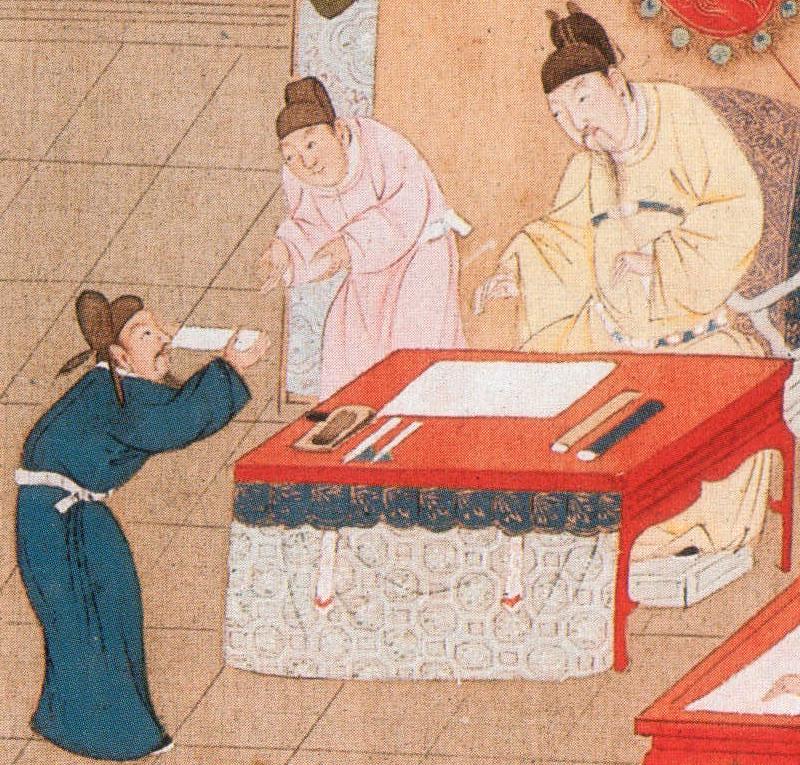
The civil service examination system was one of the most important Neo-Confucian institutions in the Sinic sphere Source
What’s interesting, Chinese annexation of lands in east and south had to end somewhere due to logistical constrains (difficulty of projecting power over distance). Apparently, Vietnam and Korea, and certainly island Japan, were beyond the comfortable range where Chinese could control them directly. China occupied north Vietnam on several occasions (last time in 1408-28), and there were a series of wars against Korea (by the Han, Sui, and Tang dynasties, all before 1368). But eventually Chinese decided that it was not worth their while to conquer and hold these regions. It was just like the Roman Empire deciding in the first century CE that conquering Germania was not worth it.
Meanwhile, (neo)Confucian institutions and other Chinese cultural elements (such as the system of writing) had diffused to Korea, Vietnam, and Japan, who became, as a result, “Sinicized.” These countries looked up to China as a political and cultural hegemon; to a greater (as Korea) or lesser (as Japan) degree. By 1368, the geopolitical system in East Asia evolved to have the following features. China was acknowledged as a hegemonic power. The neo-Confucian states accepted this hegemony, and entered into tribute relations with China. Again, there were differences: Korea was the most accepting of this unequal relationship, Japan the least, and Vietnam in between.
In return, China guaranteed territorial integrity of its vassals, and—remarkably—stuck by this guarantee. It did not use its preponderance of power to annex the subordinate states. Even the Chinese-Vietnamese war of 1408–28 is not, really, an exception to this rule. It started because the Chinese intervened on the side of the old dynasty, Tran, against the insurgents. Then, however, the Chinese uncharacteristically chose to stay. But after 20 years of war against the new dynasty, Le, they decided that annexation of Vietnam wasn’t worth the resources they were spending on it. So they recognized the Le dynasty as the new vassal replacing Tran, and got out.
Things were so peaceful during this period for Korea that they did not have much of an army in 1598. When the Japanese warlord Hideyoshi invaded Korea with 160,000 troops, the Korean army had less than 1,000 soldiers.
Hideyoshi used 700 ships to transport his huge army to Korea. Source
Hideyoshi overrun the whole Korean peninsula, but Koreans asked for Chinese help. Chinese arrived with 200,000 troops and kicked Hideyoshi out.
(Sounds strangely familiar, doesn’t it?)
Toyotomi Hideyoshi unifed Japan and invaded Korea Source
Once the Chinese took care of Hideyoshi, they left. They did not annex Korea, but restored it back to the Korean authorities (king Sonjo).
This is a remarkable story. Pax Sinica (not the term that Kang uses)—the hegemonic domination of the Sinicized neo-Confucian sphere by China—endured for five centuries. Yes, all the countries in it fought many wars during this period. These wars were against “barbarians,” such as the steppe people, Manchurians, Ainu in Japan, Wako pirate/smugglers on the coasts, and Southeast Asian states other than Vietnam (Siam, Burma).
China alone fought in more than 250 conflicts on its western and northern frontiers, ranging in scale from border skirmishes to the Manchu conquest of China. That permanent frontier generated the evolutionary pressure that resulted in the rise of one China empire after another. But within Pax Sinica interstate relations were remarkably peaceful.
At the end of the book Kang muses about the implications of China, leadership, and hegemony for the twenty-first century. He doesn’t expect the world system, dominated by the USA, to change much. “The United States is not going to disappear from the region.” Perhaps. But as China continues to rise, and America continues to decline, who knows what the future of East Asia is going to be. If China again achieves a hegemonic power, and if culture is persistent (and evidence is in favor of that), then perhaps the Sinic-centric configuration would not be really that bad.
Blog Archive Comments 8 comments Comments originally published with this post. This archive is read-only.
Gene Anderson
Right. A few things to note, however. First, Ming was not rich. They kept taxes fairly low and were not good at milking the extensive marine trade. They couldn't afford many ventures. Second, what happened with Vietnam was mainly that the Vietnamese are utterly implacable fighters and just won't accept defeat. In fact, based on Vietnamese history, all knowledgeable advisors from Samual Griffith (the Marines' expert on Asian war) to the CIA told Kennedy and Johnson exactly what would happen if the US went into Vietnam. And it happened. Third, the Little Ice Age saved Ming from Central Asia; it utterly devastated the Mongol-Turkic world. Graphic story: Tamerlaine froze to death on his way to conquer China. (Well, died of disease in an extreme cold snap. Close enough.)
admin
Ha, I didn't know the details of Tamerlane's death!
Lorenzo from Oz
The Ming were able to build the last-and-best version of the Great Wall, so still had considerable resources, at least early in their rule. They were also the first "gunpowder empire". It depends on what period in the dynastic cycle you are talking off. Peace led to population increase in excess of production increases which pressured living standards (encouraging revolts) and ability to extract revenue (which weakened the dynasty). See this enlightening paper: http://www.sciencedirect.com/science/article/pii/S0014498314000205 (An earlier ungated version is available.)
David Huang
Didn't the Little Ice Age also devastate Ming agriculture, fuel the rise of peasant rebellions (most successful of which by Li Zicheng took down the Ming empire before getting beaten by the Manchus).
Jack Doel
1. Ming was rich enough to build Forbidden City, fortify great wall(even in their decline period), launch 12 giant land expeditions, 7 giant marine expeditions, maintain one million regular army(30~%40% of them with firearms), even develop early stage capitalism society. 2.The reason of China ceased to control Vietnam is a bit more complicate than you think. Vietnam was China's territory for nearly 1000 years and China's tributary state for another 900 years. 3. Little Ice Age happened AFTER Tamerlane's death, and it also affected Ming China. But even if Tamerlane didn't die that soon, he can't necessarily beat Ming since Ming was also under the rule of a very capable warrior emperor who defeated Mongols several times.
Lorenzo from Oz
I would have thought that the sheer dominating size of China in this period was a factor. Whenever there was a more extensive state system, (say the Warring States period, or the Song period), Chinese history was very inter-state violent. Moreover, modern China is actually rather more likely to use violence (or the threat thereof) in its interactions with other states than other Powers. So, I would be much less inclined to draw comforting "cultural" stories from this particular period. https://www.princeton.edu/politics/about/file-repository/public/Chin-China-MIDs-Paper_2013.03.11.pdf
Ross Hartshorn
I think one could argue that modern-day China might be the reason for North Korea not having started a war in the last couple decades. The presence of American troops in South Korea surely plays a big role as well, but I'm not sure it's the only one. My best guess is that North Korea is getting strong "don't make trouble for us" signals from China, and while they may not be heeding them as well as we would like, I could easily imagine that North Korea would have taken advantage of our problems in Afghanistan and Iraq during the end of GWB's second term, to try to attack South Korea, if China were encouraging them to rather than discouraging. Not to say that there's anything particularly Sino-specific about this; regional hegemons often try to prevent their neighbors from stirring up trouble. But still, perhaps an encouraging sign that they may already be having an influence on some neighbors towards more peaceful behavior. The main worry, I think, is whether or not a deteriorating economic situation would make China more likely to try to stir up trouble (with Taiwan, or Japan, or somebody else) as a way of distracting their own populace from economic troubles. Cross fingers...
Conformation
“The remarkable observation that Kang makes is that during the five centuries before Western domination these states fought a total of two wars among themselves. ” In fact,Qing tried to invade north Vietnam when Ruan Dynasty took place of Li Dynasty there in 1788.