In the previous post of the series, I promised to show how both the Economic Power and Casualties Rates hypotheses can be combined within the same computational model. Yesterday, the SocArxiv finally published my preprint describing this model (it took several weeks to resolve some bureaucratic issues), and I now can direct readers to it:
Empirically Testing Predictions of an Attrition Warfare Model for the War in Ukraine
Furthermore, thanks to my research assistant Jakob, you can now play with the model yourself:
The AWM is quite straightforward--essentially, an accounting device. The key assumptions are (1) future dynamics of war materiel production by the contenders, (2) how materiel is translated into casualties, and (3) how the end point is determined. The details are in the preprint.
But the overall message is very clear. Once the war settled into the attrition phase (by the end of 2022), and it was clear that Western sanctions failed to shut down Russian productive capacity, the eventual outcome became, essentially, a mathematical certainty. Of course, there is always a possibility of a low probability ("fat tail") major game-changer, but conditioning on that it won't happen, the model predicts, ultimately, Russian victory. This prediction is encapsulated in this graphic (which is a bit more sophisticated version of the main chart in the post I published in July, War in Ukraine IV: Projections):
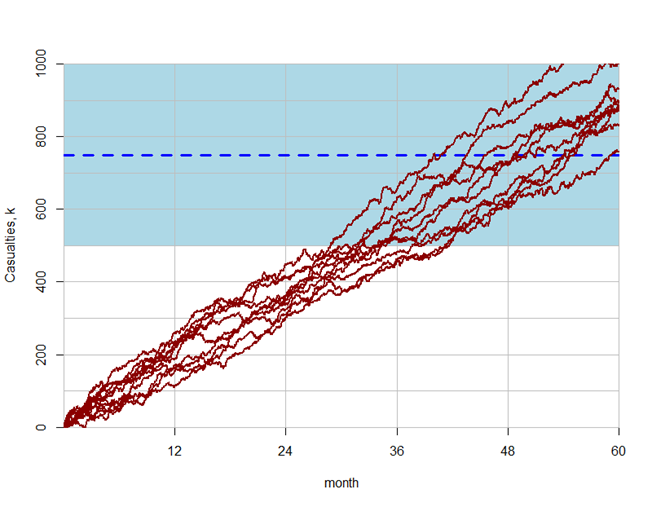
Ten realizations generated by the AWM for the dynamics of Ukrainian casualties. The blue band represents the estimated end point (the level of casualties when the war becomes unsustainable).
While the final outcome is not in doubt (again, barring a game-changing event), there is a lot of uncertainty about how long the conflict will last (in the model, a brown curve intersecting the level somewhere within the blue band). Some of this uncertainty is due to various random events affecting the prediction, but even more is due to lack of precise knowledge about the model parameters and initial conditions (such as initial stocks of shells and rates of their expenditure), The latter problem will be somewhat ameliorated after the war ends, when better knowledge becomes available.
As I explain in the preprint, I used the AWM to explore what it would take to reverse the predicted outcome. It looks like an early suppression of Russia's capacity to produce munitions is a necessary condition (but I would be curious to hear if a reader finds another set of assumptions). Since this didn't happen by January 2023 (when the two alternative predictions, discussed in the previous post, were made), it is now clear which prediction was based in reality, and which was not.
Blog Archive Comments 51 comments Comments originally published with this post. This archive is read-only.
Andrew Wilson
Can your model reflect the psychodynamics of the armies? And isn't there some chance of a "1917" scenario, where the Russians, grown tired of suffering and dying for benefit of a kleptocratic elite, shoot their officers, and go home? {We've already seen something not unlike 1917 from Wagner Group.}
Olivier
To be honest I wonder why you even bothered with the economic side. In WWII the US retooled their entire production apparatus to put it at the service of a total war economy; that is emphatically not happening now. All the production capacity in the world is irrelevant if you decide not to use it. Moreover said capacity is probably overestimated. Western arms merchants nowadays excel at making fantastically expensive doodahs in small series. not basic stuff in large quantities. As luck would have it I ran yesterday into an Associated Press report: https://news.yahoo.com/watchdog-western-arms-companies-failed-230315652.html claiming that Western arms companies failed to ramp up production capacity in 2022; ironically they gave the Ukraine war as a reason. Clearly at this point the Western side is unserious about the war (as it is about almost everything), which makes its fabled production capacity doubly irrelevant.
Peter Turchin
Thanks for the link -- very interesting. The reason I added the economic side is to accommodate Krugman's hypothesis. It is true that materiel production didn't ramp up, as he expected, but this was an important possibility. Think about the model as it allows one to explore counterfactuals.
Ross Hartshorn
Interesting! One thing I'm curious about, that is missing from this model, is the reaction of the various nations backing Ukraine if they see a likely Russian victory. We got an early example of this when American political disputes held up Ukraine aid, and Germany responded by doubling its budgeted outlays for Ukraine aid in 2024. Of course, Germany still probably did not see the prospect of a Ukrainian victory. What would Poland, for example, do if it saw the prospect of an imminent Ukrainian collapse? I am reminded of the situation in World War I, where Germany's successes in mobilizing both men and material were overwhelmed by the fact that they kept accumulating enemies. Even in 1918, an additional enemy (Brazil) joined the war against them (although very few Brazilian troops got to Europe before the war ended). The U.S. definitely sped up its deployment of troops to Europe out of concern that the fall of Russia was going to allow Germany to achieve a breakthrough in the west.
Vic K
I am reminded of the situation in World War I, where Germany’s successes in mobilizing both men and material were overwhelmed by the fact that they kept accumulating enemies. The World War I was between Allied Powers and Central Powers, not between "Germany and its enemies". E.g., Austro-Hungarian and Ottoman empires were not Germany.
O. Alexander
Unbeknownst to most, from 1918 to 1925 the Americans also kept themselves busy in Russia. Always tirelessly fighting for democracy and human rights. https://en.wikipedia.org/wiki/Allied_intervention_in_the_Russian_Civil_War
steven t johnson
Not sure how this is relevant. My first impulse is to read this as irony, but this thread has some deranged people posting. The initial Hartshorn comment was erroneous in a sense. Germany was defeated in the sense that there was no way it was going to win. When the revolution broke out (triggered by an absurd plan to waste lives in a strategically pointless naval foray as I recall) the German army decided to attack the rear, that is, the German people. If you can't beat them and you can't join them (them being the Allied powers) attack someone you can maybe still be strong enough to beat, that being as the revolution. It is of course a truism that the defeat of the German revolution was a Good Thing, but considering the continuity of the imperial army, the Freikorps and the Nazis, this dogma I think really needs to be rethought.
Natalie
Very sad but unfortunately looks like the only logical outcome as of todays conditions.
Allan Groves
so you see this as essentially an attrition of troops willing to fight before the munitions give out? Is the death of Putin exogenous to the model, and would that make any difference in resources available in Russia?
Peter Turchin
In this approach, we do not follow individuals. Deposition of Putin or Zelensky would matter only if it results in a change of policy. The Russian ruling class seems quite consolidated at the moment, so Putin as individual doesn't matter much.
Nathanael
The degree to which this is an incorrect analysis of the Russian ruling class (such as it is) cannot be overstated. Putin as an individual is essential. Pre-war analysis was that a full-scale invasion of Ukraine would be incredibly stupid: setting fire to Russian resources and power and destabilizing the Russian government internally, for no benefit whatsoever to the Russian ruling class. It was, and it is, this stupid. Most of the Russian ruling class isn't this stupid. The war is driven by psychodynamics -- by Putin's promotion of Russian chauvinism. Yes, part of the Russian elite is fanatical Russian chauvinists who believe that "Ukraine isn't a real country" and are willing to smash Russia in an attempt to prove it. But *another* part of the Russian elite just wants money and power for themselves and knows enough to cut their losses on a bad deal. The moment they get into the ascendant, they cut their losses and change policy entirely.
steven t johnson
The US ruling class/political leadership is united largely on moving away from elections and such, while it is sharply divided on what policies to execute. So far as I can tell no faction of the US ruling class wants peace with Russia (or anybody else,) but factionalism is imperiling the common goal. The political leaderships in the EU are by and large even more unstable and unpopular and have difficulties in reconciling their own status with obedience to the US. Very few European states have widespread and committed popular support. And some of the EU or NATO countries are also in parlous socioeconomic condition, circling the drain even. Perhaps this is most obvious in someplace like Lithuania but in their own various ways the UK, France, Italy, Spain, Greece, Hungary and Poland cannot be assumed to be commitment-capable. To put it another way:The notion the war began in Putin's head is not a hypothesis worthy of debate, it's a tacit premise of pro-war propaganda so far as I can see, end of discussion, or it should be.
UserFriendlyyy
There is also the fact that we flat out can't manufacture artillery shells because the sole point of business is to enrich shareholders, consequences be damned. Even if that means consolidating and offshoring the defence industrial base. https://www.theamericanconservative.com/americas-monopoly-crisis-hits-the-military/ https://www.thebignewsletter.com/p/the-military-industrial-stock-buyback?utm_source=%2Fsearch%2Fdefense&utm_medium=reader2
Peter Mott
I see the output of the model but not the model itself?
Peter Mott
Ah - wrong link, sorry!
Deuxglass
Munition production is very important as long as you are producing the right type of munitions. Battleships vs aircraft carriers is the best example for WW II and for this war we see that tanks are less useful than drones and SSM missiles. Artillery is still important but precision artillery is even more so. Since Ukraine has rendered the Russian Navy impotent in the western Black Sea you could say that for that mission Ukraine has been producing or given the right munitions and the failure of Russia in that area tells me that Russia has not made the right munitions for that mission. Just an example and I am sure there are others some of which would show Russia more favorably.
Peter Turchin
Naval operations in Black Sea is a side show. The model simplifies things by ignoring such secondary factors.
Peter Mott
The Shiny interface does not allow to change the relative casualty rates of Russia and Ukraine. Given the nature of the original Lanchester equations (which are embedded in this model) this ratio determines the result. The side with the smaller number of soldiers must preserve them much better to have a chance. Another point is that the Lanchester equations have constant relative casualty rates, but that is a major and highly questionable assumption. Final thought. If the war ended today with Russia obtaining all the land it presently holds that would be a victory for Ukraine - it would become a major free European nation like Poland (itself under the Russian yoke for decades). Territory in this war is secondary. Putin would of course not concede this as things are at present.
steven t johnson
Ukraine was not a major free European nation before 2014, but a pitiful basket case. The references to Poland suggest an imaginary history. If I remember correctly about half of Poland's foreign debt was canceled, as a sacrifice presumably to fight Communism. And if I remember correctly postwar planning for Ukraine suggests Ukraine is to sell, sell, sell to foreign corporations its valuable farmland and everything else. (So I understand from an analysis by Michael Roberts at his thenextrecession blog.) But since the goal of the Kyiv government is to repress the ethnic Russians/Russian language speakers in the lands where they predominate---what was long ago called Novorossiya---that is, in a way, to conquer Russian national lands that were not part of the Russian Federation, losing the territory they wanted would be a terrible defeat. And it would be a terrible political defeat for the fascist core of the Ukrainian armed forces vis-a-vis its internal rivals in Ukraine.
Peter Mott
I am getting blind in my old age. The casualties can be set under a tab on the right. According to the unadorned Lanchester model a population 3 times the size will only be defeated if its suffers 3^2 = 9 times the rate of casualties. If you change the Russian casualty rate from 0.03 to 0.27 (nine times the Ukraine one) then Russia runs out of soldiers before Ukraine.
Peter Turchin
Good to hear that you got it to work. Yes, an order of magnitude increase in the efficiency of Ukrainian shelling will reverse the outcome. Of course, there is no empirical basis for this assumption.
Nathanael
Yeah, the Lanchester equations have been shown to be a poor model for most warfare long ago. In particular, any actual analysis of the Ukraine war needs to look at actual relative equipment loss rates, and actual relative casualty rates (which are harder to determine). Ukraine is doing far, far better than Russia by any realistic measure. Phillips O'Brien has numbers. The Ukrainian military is at least 3 times as efficient as the Russian. Russian population and production capacity? Less than 3 times that of Ukraine. Your mathematical model doesn't need to be that complicated to make a projection from this data. https://phillipspobrien.substack.com/p/why-can-ukraine-win-because-its-military That said, the defining matter is going to be morale. Perun, who makes a lot of YouTube videos on defense economics, points out that countries can keep conducting wars long beyond any model of economic sense, with the question essentially being one of morale. Russia's morale breaks first. Ukrainians are ready to fight with poisoned food and Molotov cocktails for the next 50 years if they have to (the polling is clear), and Russians aren't. I would suggest that Turchin do some retroactive projections from the Lanchester model, which predicted that the USSR would win in in Afghanistan, that the US would win in Afghanistan, that the US would win in Vietnam, and all kinds of other things which obviously never happened. In all these cases, the morale issue was the most obvious reason the Lanchester model is useless.
steven t johnson
If you go back to the first post that discussed Osipov-Lanchester, it is clear that the predictions of a purely attritional war assume that morale is roughly equal. That's why the possible endpoint is set by manpower and materiel capacity. The model aims to determine what the probability of a collapse from attrition could be. This hypothetical is a boundary or limit. I have my own disagreement, namely that attrition is non-linear because acquisition of territory changes capacity for resupplying manpower and materiel. Your disagreement is, morale isn't equal. Your problem is you have no good evidence to support your claims. They are ideologically motivated so far as I can tell. Polling can be done so that it is statistically reliable but polls even when they are done honestly, they are limited to 1)the questions asked and 2)estimates of a wildly variable mood, not measurements like height and weight. Polls can even be designed as political interventions meant to change opinions, not measure them. A vague reference to polls is as sound as invoking the horoscopes of Putin and Zelensky.
Mao Cheng Ji
"the defining matter is going to be morale" I suspect the role of "morale" is hugely overstated. If you can't emigrate (as is the case in Ukraine), then you will be conscripted eventually. You will be conscripted and sent to the front line. There will be an anti-retreat unit behind you, that will kill you if you try to retreat or surrender. And that's all the "morale" there is. "Ukrainians are ready to fight with poisoned food and Molotov cocktails for the next 50 years if they have to..." Now, that's just nonsense.
steven t johnson
In the sense Nathanael meant, you are correct. But I would add that troop morale is equally irrelevant for the Ukrainian militias in Donetsk and Lugansk and the SMO forces. For most purposes, it serves to simply assume both sides have roughly equal troop morale, which functions to ignore or minimize the role of morale. Morale on the home front in the sense of political opposition (among elites, I hasten to add) matters more. But for that purpose, the occupation of territory is the sign of victory that sustains morale. That's why attrition is non-linear in my view. Winning is the wind in the sails, but losing sinks the ship. That's why the defeat of the advance on Kyiv in 2022 was a morale defeat for Putin, regardless of whether it was a feint to pin down forces or a gamble on panicking Kyiv into a ceasefire and negotiations. It, like the entire SMO, was never large enough to constitute an effort at conquest of Ukraine.
steven t johnson
It still seems to me that the role of territorial acquisition in attrition is not clearly established in either model Recovery from losses and mobilization of resources hinge on territory. Also in this particular case, where it really is a war between the US and its subordinates with Russia, the notion that the casualties in Ukraine matter is equally unclear. The projections all suggest the probability that the political situation in the US and subordinates will change. Entry of NATO troops in some form is a significant possiblity that will wreck all projections I think.
Paolo
I don't think that before US election the entry of NATO troop in some form is a possibility. But casualties in ukraine matter as the west to date give money and materials but not men.
O. Alexander
If you consider a Nato intervention you would want to ascertain what the European members have to offer, and the you check what the Americans could throw in. In this context remember the unchallenged US build-up for the Gulf Wars.
Paolo
There samething strange in the link between data a d grafth in the AWM: if i change casualty rate even shell production and stock picture change
Peter Turchin
This is probably due to stochasticity. Set random factor to 0, and check whether now the production and stock curves change.
Alan Patrick
Very interesting model, thanks. Fwiw I've been monitoring the attrition of equipment (from the Spioenkop OSINT website) pretty much since the war began. I've attached the weekly cumulative equipment loss ratio (Russia vs Ukraine) in the chart, its from w/e 12 March 2022 to w/e 10 Dec 2023. The ratio is about 2.8 : 1 in Ukraine's favour at present, slowly declining. IMO it gives an indication about how the war is being fought (Russia has been almost constantly at this sort of loss ratio or higher each week, ie is almost permanently on the offensive). If the Spioenkop ratio is an indication of the actual manpower attrition ratio it would be similar to the population ratio (c 100m to c 40m) so at a % of population level attrition they would be similar. Of course it's all moot if the US will no longer supply Ukraine...
Peter Mott
"from the Spioenkop OSINT website)" Do you have a url to share?
Alan Patrick
This is the link for Russia, go to the bottom and it links to the Ukraine one https://www.oryxspioenkop.com/2022/02/attack-on-europe-documenting-equipment.html
Peter Mott
Thank you
Operations Analyst
2 points of Info: • Russia offensive posture increases the loss ratio of platforms-infantry. • Russia terrible infantry quality and tactical employment decreases their platform-infantry loss ratio But overall, yes, the discrepancy between the platform loss ratio and the personnel loss ratio needs to be reconciled!
Vic K
It looks like an early suppression of Russia’s capacity to produce munitions is a necessary condition (but I would be curious to hear if a reader finds another set of assumptions). Another way is boosting AFU's numbers directly, by sending large numbers of manpower (e.g., "foreign volunteers for the AFU" or whatever). There are/were some, but I'm talking about something similar to PRC's intervention in the Korean War. This obviously won't happen, due to intense fear. I find it interesting, and it reminds me of Glubb's "Fate of Empires" - the bit about "money being in better supply than courage".
Alan Patrick
Glubb is a very interesting read just now IMO
Marcus
Very useful, thanks. Some comments: 1. The Russian mobilisation/recruitment rate is higher than 300. It should be set at about 650 a day at least. If I change this it gives exactly the number that Putin yesterday said are serving. 2. The NATO countries did not really ramp up production, they emptied their own stocks and those of others (Israel, Korea). I don't think the NATO production capability is larger than Russia's. And Russia got access to North Korean stock/production. 3. Ukraine said that during the counteroffensive they managed a 1:1 ratio in artillery, so they have been living above their means for some time (e.g. consuming stocks that won't be replaced, because the production in NATO countries has not increased significantly), The result is that from roughly now on, Russia for the first time has a numerical advantage and the Ukranian stocks have declined more steeply. If Russia just keep pressure to force the Ukranians to consume stock, they will bear crush them and open possibilities for a new offensive in northern Ukraine during the summer of 2024.
Peter Mott
Start simulation with 0 randomness and a 9 year war. Set the initial rate of Russian production increase to 10 (same as Ukraine). Russian army hits zero just after 9 years. Casualties inflicted are about the same so change the rate in Ukraine's favour to 0.05 (from 0.03). The Russian army hits zero at about 5 years 9 months, Ukraine casualties are supportable. The graph for Russian casualties has an odd kink in it where the Ukraine one is a straight line. I don't know why the model does that. Of course the model has no built in starting date so you could run it from, say, September 2023 after the failure of the Ukrainian counter-offensive. But absent correct data it's a largely academic exercise, though a very interesting one!
Alan
Interesting full essay on current conditions by Gen. Valerii Zaluzhny, CiC Ukraine armoured forces. Talks in detail about the artillery, manpower and related logistics issues plus other issues https://athenalab.org/wp-content/uploads/2023/11/ZALUZHNYI_FULL_VERSION-2.pdf
Nathanael
Garbage in garbage out applies. The AWM is just wrong as a model, because the war is lost not when the country is physically out of men, but when it's out of men who are *willing to fight*. It's absolutely clear what the outcome is: Russian loss, and specifically, Russian loss with the Russian government collapsing. And the reason is YOUR model for societal collapse, which is actually decent, unlike this AWM model. One added footnote: Russian munitions data is mostly dishonest. The fact that Russia is importing weaponry from North Korea tells you the actual state of Russian weapons manufacturing capacity.
steven t johnson
Cashiering most of the heads of recruitment for taking bribes from men who were not willing to fight shows the question of who's putting in garbage is not answered yet. And this doesn't even consider the question of Ukrainian emigration which is much greater than Russian emigration. Morale is not just being willing to fight, it's also being simply willing to stay in the country. Ukraine has a smallish cohort of fighting age men because of emigration. The morale argument is against Ukraine. Personally I find this satisfying because I have a strong feeling that ordinary people don't really commit to fascism.
Operations Analyst
Numbers beat words. Russia has a higher ratio of emigre men per recruit than Ukraine has. And a much higher ratio of desertion.
steven t johnson
https://upload.wikimedia.org/wikipedia/commons/thumb/9/92/Ukraine_2023_population_pyramid.svg/1280px-Ukraine_2023_population_pyramid.svg.png
Robert McMaster
In The Arms of Krupp William Manchester described how the Panther and Tiger tanks were 'junked up' with fussy and complicated hardware. Because such boosted their manufacturers' profits. But, they broke down constantly and were very difficult to service. Nowadays, this is being termed 'enshitification'. As in the F-35. Or the entire UK navy. The Zumwalt. Under the stress of actual combat with a peer adversary like Russia ceremonial gear like this will fail.
Georg Georgowicz
what about nato vs. russia? also, why did russia have to go into attritional warfare to begin with?
Alan
Peter, I was researching simulation models for military campaigns and I found a link to the Collins model in the Cliodynanamics Journal from 2011, which reminded me of this post. I wondered if you'd considered that model at all, as it brings morale into the picture?
steven t johnson
If other models are being considered, there is Tactical Numerical Deterministic Model from Trevor Dupuy. (Previous version was called the Quantified Judgment Model.) There is a Dupuy Institute which presumably has all the information up to date.
David Arens
I believe that you are on a right track of comparing the attrition rates, but does anyone have something to deal with the attrition of the Russian equipment. In Africa, and other parts of the world, the US was buying up equipment to give to Ukraine, and the Russians are sending military hardware and people to defend their allies from possible future issues. And I don't know if anyone has information on the amount of foreign fighters coming in on either side? Side variables also indicate this may be a 30 years war with both sides decimated from future fighting going on in the area, and more limited small scale fights in the future. Also does anyone have info on the Mercenary front, these groups are moving around and are not in the public eye.
Operations Analyst
I'm a senior Operations Analyst based in the UK. Statistician. Economist. Quantitative Historian. I've got 30 years of experience in the generation and use of strategic outcome combat models based on historical data like this. I ran the cell that did this sort of work, back when this sort of work was done properly. Your heart is in the right place; and this is a very, very, good "amateur" effort (no disrespect intended). The overall attrition-outcome architecture is reasonable. However, I think the artillery emphasis, artillery-casualty mechanism and other details are sufficiently off that I wouldn't have confidence in it. This is said respectfully in a "all models are wrong, some models are useful" sense. 1. "Victory" or level of relative concession not adequately defined and lacks resolution. e.g. Is it a Russian victory if Russia gets Donbass but Ukraine core state survives and goes on to join NATO? 2. The general artillery model is "sufficiently wrong"; as follows 2a. Offensive and Defensive artillery use at operational level have very different effectiveness - defensive is better - and the Ukrainians are overwhelming in an operational defensive posture. 2b Asymmetry. If Russian heavy artillery effects per shell, ceteris paribus, are within a factor of 1.5 of Ukrainian ones, I'd be staggered. If within a factor of 3 I'd be mildly surprised. 2c. Artillery casualties tend to be _less_ lethal than other types. If one side is inflicting primarily artillery casualties and the other is inflicting primarily FPV + direct fire kills. .. 2d. Beware the statistical inference that because 80% of Ukrainian casualties were artillery, the same goes for Russia. Russia is taking a much greater share of FPV and direct fire casualties, in accordance with their operationally offensive posture. 2e. ISTAR really matters in artillery duels - at least as much as weight of fire. Ukrainian ISTAR is probably at least as good as Russian, and that's before US intel is fed in. 3. Casualty Thresholds. It's not the population that matters; it's the population that that state is willing to sacrifice. That's why Vietnam turned out as it did. 3a. Consider rising cost of Russian recruitment bonuses and Putin aversion to tapping Moscow and St. Pete. Russia may have more men - it may not have many more _politically usable_ men. 3b. Ukraine can mobilise more of its manpower than Russia - their smaller domestic economy is underwritten by large foreign cheques. Russia can't - it's already taking quite a lot of overheating at current levels. 3c Yes, casualties DO link to general support / defeat thresholds in the Open Source data. However, this sort of model you need to link different casualty thresholds to different levels of defeat. Again, the Open Source data shows that people will take more pain for a perceived existential war than otherwise. Authoritarian states do have some advantage here - so it's not all bad news for Russia. 3d. Personnel casualties are important but insufficient. Russia is suffering disproportionate loss and wear of platforms (consistent with its operational posture) which in turn underpin its offensive capabilities. 4. I would treat Ritter and MacGregor with great scepticism. Of course, both sides make inflated claims, but I don't know a single professional analyst who rates their technical projections. They are partisan to the point of uselessness. 4a. Validation by casualty numbers are obviously hard to come by, but there BBC work is pretty good. Ukrainian numbers are trickier....but there are some means to estimate it which I won't post on a public forum. 5. Force ratios govern exposure rate. Otherwise this sort of model just turns into a pseudo-Lanchester. Overall: Good effort. But revise and improve.
paolo
peter what happen? 11 month without blog article: i hope is all fine for you and your family