The title of today’s blog (“The Truth is Born in Argument”) is a translation of a Russian saying (в споре рождается истина). For a long time I thought it was simply a Russian version of something that Ancient Romans would say, but as far as I can tell, there is no such Latin proverb (please correct, if I am wrong!). Apparently, the Romans looked for the Truth in an amphora (thus, In Vino Veritas).
But the importance of argument and controversy for Science is indisputable. Science is a collective, and also an evolutionary process. It advances by a multitude of explanations, hypotheses, models, and theories competing against each other. If a scientific discipline is healthy, then most of these ideas are eventually rejected. Rejection of a theory can happen for a variety reasons, such as being contradicted by empirical data, or if a logical flaw is found.
Traditional History (History-as-Humanity), of course, was not a scientific discipline, so for any particular question there is a multitude of theories and hypotheses, all hanging on indefinitely. My favorite example is the more than 200 explanations of the fall of the Roman Empire, with few (if any) laid to rest.
The goal of Cliodynamics (History-as-Science) is, of course to introduce a harsh selective regime that will lead to the extinction of most hypotheses (ideally, all but one). This is the kind of evolutionary “creative destruction” that results in progress.
The idea of creative destruction is at the core of cliodynamic research by myself and colleagues. For example, in our recent PNAS paper we asked, what are the most important mechanisms that explain the rise of large-scale societies (macrostates and mega-empires)? There are many theories, but we focused on three: the role of agriculture, the effect of mountains, and warfare. Note that the most commonly held view among the archaeologists (although they don’t always say it very clearly) is that resources are the main explanatory factor (e.g., the ability to produce lots of food). This view is transmitted very clearly in the writings by Jared Diamond (such as Guns, Germs, and Steel), who filters it through his geographic view of human history.
When we built all three factors into our model, we found, however, that the most important factor is warfare. Or, more accurately, intense forms of warfare diffusing out from the Great Steppes on the horseback. Agriculture and mountains play a role, but they turn out to be much less important than warfare. Essentially, where warfare is intense and chances of a whole country going under are high, countries have to grow big to survive. They either succeed in doing so, or go under and are replaced by the successive ones.
Overall, our model did a remarkably good job predicting where and when large empires arise in the Ancient and Medieval Eurasia and Africa.
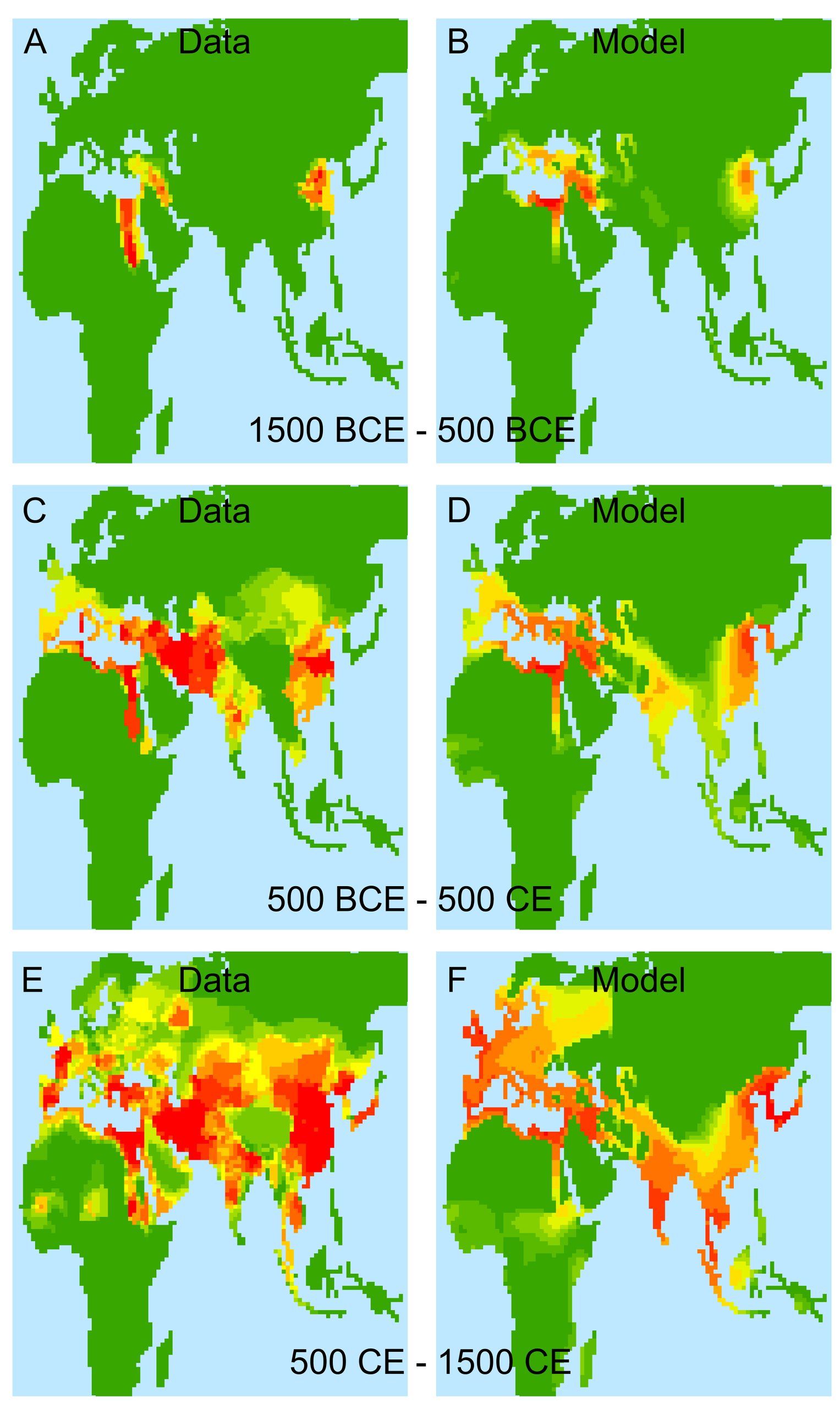
This was a striking result, but as I said earlier Science is a collective process, and our results need to convince other scientists. Furthermore, there are many theories, and no single individual, or a group of researchers could test all of them. We have to do it a few at a time.
Scientists also become attached to their theories. This is why we need others to argue against us, to propose alternative theories, so that we all can collectively butt our pet theories head-to-head. Let the best win, and others die.
Critique, dialogue, arguments, and controversy are an intrinsic part of doing science.
Now this has been a long-winded introduction to the main topic of this blog. Recently the journal PNAS, where our original article came out, published a critique of it by Russell Thomas, as well as our response.
Thomas also wrote about this exchange at length in his blog, and I’d like to respond to some of the things he said there.
Let me first say that I agree with Thomas’s general point that the format of discussion at PNAS is fairly ridiculous. Both his ‘challenge’ and our ‘response’ were severely limited in size, which doesn’t make sense for an electronic publication. Mind you, having unlimited electrons doesn’t mean that we all should write long-winded diatribes. Still, the point is that a 500-words limit (less than a page) for our response certainly meant that we couldn’t address all the points raised by Thomas. Especially because a question can be short, but an answer typically requires more space. At least, a proper answer.
But on other issues I mainly disagree with Thomas. Let’s start with one, the tone of discussion. Thomas says, “My sincere desire is that the authors will respond here in the comments or elsewhere to address these (clarified) objections.”
Yet then he destroys much of the good will he creates by saying “From the viewpoint of the scientific method, this sentence is nonsense.” I have been in the business of applying the scientific method to various problems for 30 years, so such an accusation from someone, who is still working for a PhD, is more amusing than irritating.
Lesson 1 in scientific debate: avoid inflammatory language. Focus on the substance.
This lesson is something that has not been internalized in several disciplines and in certain ethnic scientific cultures. I regret to say that British historians (or should I say English?) have been a particularly poisonous breed (I say it objectively; to the best of my knowledge, I have never been attacked by a British historian). As a review of his recent biography says, Hugh Trevor-Roper “was an undisputed, heavy-weight champion in the very English sport of scholarly controversy.”
https://www.newcriterion.com/articles.cfm/All-glass---rubber-6426
As another great British historian, R. H. Tawney responded at one point, “An erring colleague is not an Amalekite to be smitten hip and thigh.”
Poussin: Joshua's Victory over the Amalekites (Source)
OK, and on this note I am going to take a break, and resume the discussion of the Thomas critique in the next blog.
Blog Archive Comments 6 comments Comments originally published with this post. This archive is read-only.
Chris Kavanagh
While I'm sympathetic about good discussion being related to appropriate respect for your 'opponent', I think there should be some allowance for the more informal tone found on blogs. From reading Thomas' published response and blog entry, I don't get the impression that he is being dismissive or needlessly aggressive but rather fundamentally disagrees about the modelling/the defense being offered thus far and was just expressing his frustration when making the 'nonsense' comment. Regardless, it is heartening to see that the debate will receive a fuller treatment via your respective blogs, a 500 word limit might well keep things concise but it seems a much too short space for a decent discussion about multiple points. Look forward to the next post!
Peter Turchin
I am all for informality, but there is no reason to believe that it cannot coexist with courtesy and mutual respect.
Chris Kavanagh
Certainly, but I just didn't read his entry as being meant to display a lack of respect just frustration. Though admittedly, trying to read 'tone' in written text is a rather subjective (and perilous) experience!
Luke
Peter, it's great to be reading your insightful blogs again after your break! Another way to confront our ideas is to present the same model with more data, particularly data from outside the set used to generate the hypotheses. Have you tried the model on the Americas prior to European contact or are you planning to do so? It would seem the process of state selection imposed by warfare should have operated equally there, if indeed warfare imposes such a cultural selective process. There also is steppe habitat and variation in state complexity in the Native American record. Granted no horses (likely they all got eaten), but this gives you a way to test if it's really the horses that are so important.
Peter Turchin
A very good point, and we indeed have plans for applying the theory to the Americas. No horses there before 1500, but the theory is general - the driving mechanism is warfare intensity, and we can proxy it by other military technologies. Most immediately, we are going to model the effect of the spread of bow-and-arrow technology in North America on the evolution of social complexity.
labropotes
Plautus clearly understands the power of argument before a judge: "Loquere nunc, quid fecerim: Nunc utriusque disceptator, eccum adest, age, disputa." No one said it better than JS Mill; "Complete liberty of contradicting and disproving our opinion, is the very condition which justifies us in assuming its truth for purposes of action; and on no other terms can a being with human faculties have any rational assurance of being right."