As many of you know, currently the Seshat Databank project is focused on collecting data for all polities (states, empires, chiefdoms, archaeologically known cultures, etc) that intersected 30 geographic points (NGAs, standing for Natural Geographic Areas) depicted here:
So far I have visited about a third of these locations, and one of my goals in life is to visit them all. I found that visiting the places where historical societies developed, and seeing how the land lies with my own eyes, is really necessary. Book knowledge alone is not sufficient. Also, you get to see all kinds of relevant stuff in the local museums that never make it into standard history books, or even on the internet.
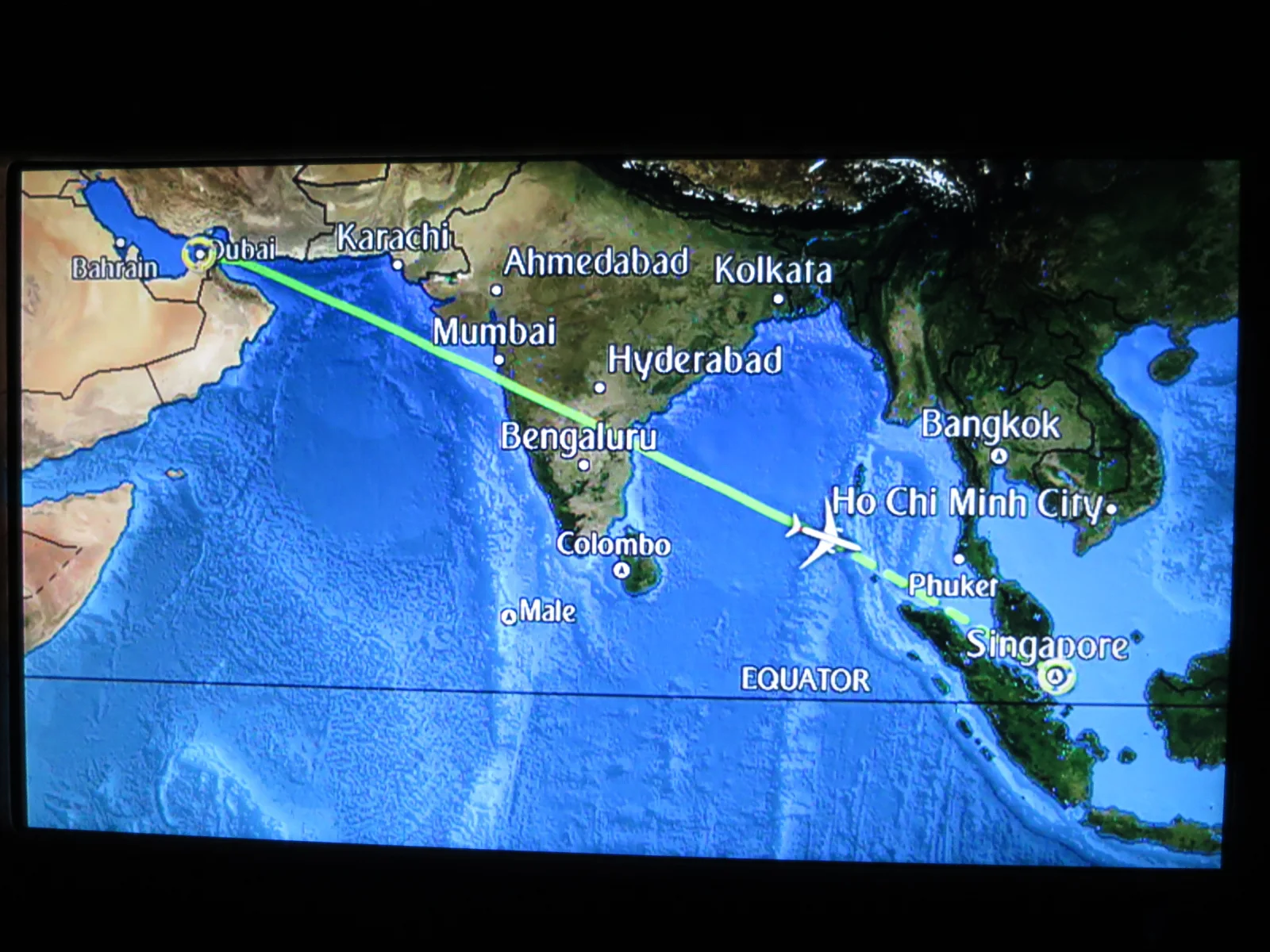
Thus, when I was invited to visit at Nanyang Technological University this August, I jumped at the opportunity. After all, here I am within easy traveling distance of two NGAs, Central Java and Cambodian Basin. A week ago my wife drove me to the Boston airport where I embarked on an Emirates airliner to go to the opposite end of the world (precisely 12 hours difference between Singapore and East Coast).
On the way to the stop-over in Dubai we flew over a lot of terrain I wouldn't mind visiting one day. This is Lake Van, the heartland of the ancient kingdom of Urartu:
As a boy in the Soviet Union, I read a historical romance In the Ancient Kingdom of Urartu, which told the story of a common Urartian stone-worker who escapes with his family the invading hordes of evil Assyrians.
A short bit later we flew over some spectacular-looking terrain: Lake Urmia, or actually what was left of it:
The flight then took us over western Persia. Without doubt there was Persepolis down there somewhere, but pesky clouds prevented me from seeing the landscape. Oh well, one of these days I am sure to be able to visit it, especially now that the US-Iranian relations have taken the turn for the better.
We were delayed in Dubai for more than six hours due to the Emirates plane catching fire upon landing (fortunately, all passengers and crew were evacuated safely; unfortunately, one fire-fighter lost his life). We landed right next to the smoking ruins of the plane.
Finally, more than 24 hours after I started the trip, we drew near Singapore.
Singapore (in Sanskrit Singa Pura) means Lion City. But what struck me upon arrival was a jarring disconnect between first-world infrastructure and the tropical setting. I mean, I've been to a lot of tropical countries, and they all had signs of poverty all over them. Singapore seems to be unique.
The city and the university campus, where I am based, literally drown in a sea of green. I know this is a cliche, but the city drowns in vegetation. Here's the view from my hotel room:
And here's what the NTU campus looks like:
I've been very busy since arrival -- so far I gave two talks (one here at NTU, the other at the National University of Singapore). On Friday I give another talk at the NTU Complexity Institute, and next week we are running a Seshat workshop on SE Asian history. So things are busy, but I hope to have a little time to continue my travelogue.


Blog Archive Comments 11 comments Comments originally published with this post. This archive is read-only.
anon
"But what struck me upon arrival was a jarring disconnect between first-world infrastructure and the tropical setting. I mean, I’ve been to a lot of tropical countries, and they all had signs of poverty all over them. Singapore seems to be unique." mmmm well isn't that interesting.
Richard
Visit some more tropical countries. Taiwan for instance. Or Australia (which also has a big chunk in the tropical zone).
admin
Taiwan sounds interesting. But not one of the 30 NGAs, so it will have to wait until after Xian.
Ross Hartshorn
Singapore is a fascinating exception to a lot of things One of the interesting things about it is that it's status as a nation with 1st World income levels is relatively new. They went from 3rd world poverty to 1st World wealth in about 50 years. This suggests that there are lessons there to be learned. One of them might be that it is easier to do the "right things" as a society (whatever those are) when you are a small polity. It's also the only case I've ever heard of where, instead of having to fight for their independence, they were instead thrown out by the government of Malaysia. Not just a peaceful separation, but more of a "you can't be part of our country anymore". If that's ever happened elsewhere, I'm not aware of it; most governments want all the territory they can get.
Richard
Yes, being small allows for certain strategies that simply wouldn't work for a larger state. For instance, being an off-shore banking/money laundering/tax evasion center (mostly for Indonesian Chinese), for instance. Switzerland, Luxembourg, and Ireland also follow that model to some extent. Also, being a port city-state in a key strategic location is also helpful (but can't be a strategy adapted to a larger state )
admin
Being small has been good only since 1945. Before that it was simply an invitation to be conquered (think Belgium).
O.Voron
Very true.
Richard
Yes, the small Western countries should have a high interest in the Pax Americana and related structures (like NATO) being maintained (or at least a balance of powers).
Quek
Ross, In (British) colonial times, Singapore and Malaya (Penang, Malacca) were for a long time governed together as the Straits Settlements. When the British decolonised, the population throughout the territory was close to 50% immigrant Chinese, which was a source of worry for the indigenous Malay elite, who feared for their political future. Basically Singapore was thrown out in 1965 because of our large Chinese population (yup I'm a Singaporean). Partly it was also because of the political ambitions of Lee Kuan Yew, who campaigned hard for multiracial "Malaysia" and not Malay-first "Malaya", reneging on his initial promise to stay out of Malayan politics. In fact, Singapore was originally included as part of the Malay Federation back in 1963 in part because Lee played up the fear that majority-Chinese Singapore would turn Communist if we were not incorporated into the Malay Fed. Richard, I'm not sure how much being small contributed, but Singapore was very highly developed by Southeast Asian standards at independence (transport infrastructure, social institutions, literacy rate, etc - look at photos and compare them to other regional capitals). That's surely part of the story as well, and often neglected (not least because our political elites love to crow about our "fishing village" to global city myth). Remember, there were four "Asian Tigers", and S. Korea and Taiwan were not small. Peter, I only read today that you had visited Singapore! Really sad to have missed you completely - I'm a big fan of your work. I was in NUS in 2002-2006, and then NTU-NIE in 2007 for teacher training. They're really nice green campuses. Your photos bring back many memories - thanks.
giorgios papadopoulos
The small western countries like Holland, Luxembourg, Belgium anfd others although they are different countries, organically all of them small and medium countries is one country with some of the large countries
Patrick
You may wish to research Singaporean history further via the Journal of the Malaysian Branch of the Royal Asiatic Society (JMBRAS) at the website.