Last week the Seshat project ran a workshop on "Testing the Axial Age" in Oxford, UK. The workshop brought together a small group of scholars from different fields – historians, religious studies experts, archaeologists, and anthropologists. The goal was to discuss what exactly the 'Axial Age' means, and develop quantitative, data-based approaches to testing various theories that scholars have proposed to explain it. The workshop was organized by Dan Mullins, Dan Hoyer, and Jill Levine; and funding came from the John Templeton Foundation via the research grant "Axial-Age Religions and the Z-Curve of Human Egalitarianism" to the Evolution Institute.
Here are the workshop participants:Prof John Baines (Oxford)
Dr Julye Bidmead (Chapman)
Dr Christina Collins (Exeter)
Prof Robin Coningham (Durham)
Dr Tom Currie (Exeter)
Agathe Dupeyron (Evolution Institute)
Dr Pieter François (Oxford/Hertfordshire)
Dr Dan Hoyer (Toronto)
Prof Jennifer Larson (Kent State)
Jill Levine (Evolution Institute)
Dr Dan Mullins (Oxford)
Dr Pat Savage (Oxford)
Prof Barend ter Haar (Oxford)
Prof Peter Turchin (UConn/Oxford)
Prof Vesna Wallace (UC Santa Barbara)
Prof Harvey Whitehouse (Oxford)
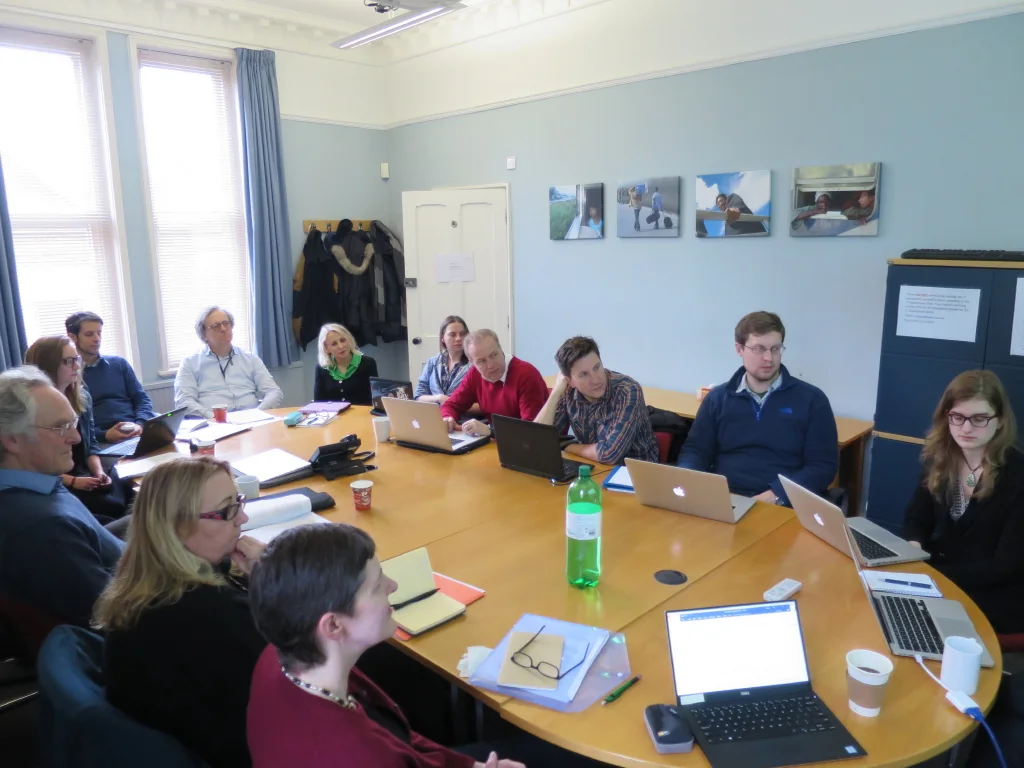
Photo by the author
The first day started with Dan Mullins providing an overview of different ideas of the Axial Age and theories attempting to explain it. Then we broke up into small groups of an expert historian and two members of the Seshat team who focused on specific past societies. I was part of the team that included Vesna Wallace and Agathe Dupeyron. While the main focus was coding how the spread of Buddhism into Mongolia in the fifteenth century affected this pastoralist society, the discussion ranged much more broadly, touching at various times on India, Tibet, China, and Southeast Asia.

Expert Vesna Wallace and research assistant Agathe Dupeyron coding data into Seshat (photo by the author)
The next day began with an overview of empirical patterns that we have captured so far led by Dan Hoyer. After that we went through each variable one at a time and discussed how it changed in different parts of the world.
Now for my take: so what is the Axial Age?
Basically, something interesting happened in far-flung regions of the Old World (technically: Afro-Eurasia) in the middle of the first millennium BCE. These regions include Eastern Mediterranean, Iran, North India, and North China. What happened is a bit harder to pin down (and different scholars emphasize different aspects of it). One of these developments was a new egalitarian ethic (relatively speaking; perhaps a better way of saying it is that the extremely oppressive and despotic forms of governance started to lose appeal). Another was the rise of religions/ideologies that transcended ethnicity and enabled integration of multi-ethnic societies. Yet another was the appearance of reflective forms of thought and considered criticism.
What's remarkable that these features are present in a variety of new religions and philosophies that appeared roughly at the same time in such distant regions of the Old World. These developments happened between 800 BC and 200 BC, with the period 600--400 BC being the most intense in developments. I should mention that some scholars extend the Axial Age to include the rise of Christianity and even Islam, but in my opinion this is not a good idea. After all, these later developments are, in a sense, secondary. If we include them, why should we exclude Mormonism, the last truly world religion to arise so far?
Such parallel developments in far-flung and seemingly unconnected regions is what cries for explanation. But what is it, precisely, that needs to be explained? How can we conceptualize, or even quantify it? How do we deal with such pre-Axial developments as the reign of Akhenaten in Egypt in 14th century BCE (well before the Axial Age)?
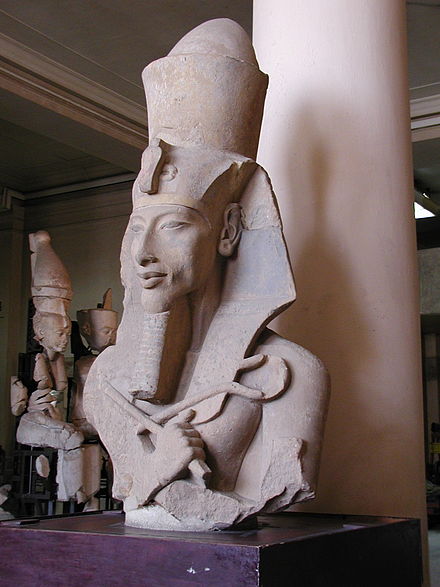
Akhenaten (Wikimedia)
It's also possible that Zarathustra lived many centuries before the Axial Age. These are all valid questions and the workshop was about how we can answer them using the "Seshat approach" (listing the rival hypotheses, collecting systematic data for a global sample of past societies, and subjecting these data to statistical analyses). A research article led by Dan Mullins, which provides details, will soon be submitted.

Blog Archive Comments 19 comments Comments originally published with this post. This archive is read-only.
Ruben Nelson
Delighted to see you are doing this. Please share any background papers (e.g. existing hypotheses to account for the Axial Age) as well as reports. I have hypothesised that by the period in question humans had had enough experience with cities in different places to begin to figure out that the deep presuppositions and ethics of nomadic peoples no longer provided a reliable and effective way to frame and live in what were the first somewhat cosmopolitan centres, (I assume both a very long learning curve and a deep stickiness of inherited cultural ways of imagining, thinking through and acting within one's world.) If there is anything in this hypothesis, then a growing cry for a "new Axial Age" throughout the 21st Century would not be surprising. We are in the process of slowly and incoherently learning that the deep presuppositions we have inherited from a past shaped by the Axial Age are no longer reliable guides to our present, much less our future. In short, no ways of seeing, strategizing about and acting that are within the ways presupposed by either regional empires or Modern/Industrial cultures can be made to be effective in the emergent conditions of the 21st Century.
Rich Howard
“new Axial Age throughout the 21st Century" Or today's "immerseration" is just good old political capture manipulating group survival mechanisms. I think immiseration is peaking now because leadership turnover happens in about 5 yr time periods and its been about 10 generations since the last reset of WWII. With political aspirants by definition desiring capture, a vicious cycle of more and more autocratic leaders is inevitable until an organization crashes. That's the capture cycle in a nut shell and we are at the end of a cycle once again. But this time we are probably at the end of a bigger 200 year cycle. Note that we see the same capture process at play in the corporate world, but with a shorter cycle time. Short enough that we euphemistically call it "creative destruction": the destruction phase is so short that, don't worry, a creative phase will be here in no time. In the corporate world you have near immediate push back of markets coupled with quarterly push back of shareholders. Capture, failure, and reconstruction occurs, but it plays out much much faster. For our government, 2-6 years election cycles, a too great presidential immunity and the ability to make laws themselves means civil war or complete dissolution may be the only reset possible after an oligarch captures government. God help us.
Rich Howard
"extend the Axial Age" I think its the Axial Age "change" that matters more than who the current winner is (religion, law, etc.). That there might be a permanent change in society structures is the important thing. Evolution is not that quick, but our "evolutionary group preservation adaptions" may have prefer different social structures as population increases?
Carl Coon
These trans-ethnic religions mark a big step forward in the cultural evolution of our species. What ties them together? Have at it, it's an important pursuit. I presume you are looking at climate variations also; they may be irrelevant but they've played a big role in other breakthroughs.
Loren Petrich
Wikipedia's article on the Axial Age mentions anthropologist David Graeber's theory that the rise of Axial-Age belief systems is somehow connected with the invention of coinage, something that happened in roughly its times and places. Also around then were large-scale trading networks, as historian David Christian has noted. An important feature of Axial-Age belief systems is universality, either a deity that rules the entire Universe or else some impersonal natural law that governs the entire Universe, like the Dharma or the Tao. So everybody can worship the same deity or acknowledge the same law.
Winston
Could it be via trade?
Ian Christie
I think Ruben Nelson is on to an important aspect of the Axial transitions. The incorporation via conquest and urban expansion of many cultures in early empires would give rise to the need for a unifying ideology and less reliance on costly authoritarian maintenance of order. And as Ruben says, tribal mythologies and ethos would come under pressure from contact with other cultures and with the new demands of multi-cultural urban management.
Michael Dalvean
This may be of interest: The Axial Age: an Examination of cognitive Evolution: https://www.academia.edu/25063310/The_Axial_Age_An_Examination_of_Cognitive_Evolution Michael Dalvean
Michael Dalvean
Another interesting paper discussing Axial Age: https://arxiv.org/pdf/1612.09268v1.pdf
Loren Petrich
An interesting feature of this paper and the previous one was evidence of a sort of cognitive shift in the Axial Age, a shift toward greater abstraction. Could that somehow be related to Axial-Age universalism? As in, one needs more abstract thought to do universalism successfully. Another factor may be increasing acceptance of written language. It was much older than the Axial Age, but one philosopher during that age, Plato, addressed what may have been a big controversy in his society. Near the end of his dialogue Phaedrus, he imagined the king of Egypt objecting to writing as something that would make people's memories atrophy and also that would give people the appearance of great learning without the reality of it. So could Plato have been noting that some people in his society made arguments like that? But anti-writing people have not left much written record, and all we have of them are from people who were opposed to their position, people like Plato.
Michael Dalvean
Universalism is certainly associated with linguistic abstraction. Abstract language is associated with 'big picture' thinking whereas concrete language is associated with small picture/highly contextualised thinking. A good place to start with this idea is Trope, Yaacov, and Nira Liberman. 2010. Construal-level theory of psychological distance. Psychological Review 117(2): 440-463. In relation to writing and abstraction, the connection has been posited (Poletti, F., 2002. Plato's vowels: How the alphabet influenced the evolution of consciousness. World Futures: The Journal of General Evolution, 58(1), pp.101-116.).
Michael Dalvean
Yet another interesting linguistics-based paper on the Axial Age http://journal.frontiersin.org/article/10.3389
Loren Petrich
That's a bad link. Where else might that paper be?
Michael Dalvean
Try this: http://journal.frontiersin.org/article/10.3389/fnint.2012.00080/full
Loren Petrich
That link worked. It's interesting how the amount of introspection rises and falls in some cases. Like reaching a peak around Alexander the Great, then another peak around Marcus Aurelius. Not long after MA was the Crisis of the Third Century, a period of strife and civil war. For the Judeo-Christian one, the authors could have used Church Fathers and Talmud rabbis as additional sources of data.
Michael Dalvean
Wars and crises do seem to be negatively associated with introspection (consider the modern cultural record of introspection in Fig. 3). Interestingly,in the modern period, the peaks seem to significantly precede the onset of war. An interesting phenomenon indeed!
Ruben Nelson
Loren, Interesting probe. Your example from Plato maps on to the experience of Israel. The first attempts to write down the scriptures (Christian's call the Old Testament) was during the exile in Babylonia about 500 CE. And there it is recognized that Israel had originally been a nomadic tribal people (without writing, I assume) "a wandering Aramean was my farther" and was now a "nation like other nations," settled with cities and a King (and writing, I assume). Of course, history is never shaped by single forces, no matter how powerful. But the shift form aural to written cultures is huge. I term it a shift in the "form of civilization." Does anyone know of research on northern indigenous peoples who have made this shift in living memory? It might shed some light on this hypothesis.
Peter Turchin
Thank you all for those comments, and for article pointers! I've been traveling, with an uncertain connection to the internet, and thus unable to respond (but I am now back home, so this will change). I passed on the info about the articles to other Seshat folk. We will be using them in several publications that are being prepared on the Axial Age.
Michael Moser
There is another example of short lived reform from the 24th century BC, the reforms/legal code of Urukagina of Lagash https://en.wikipedia.org/wiki/Urukagina also started as administrative reforms, then he had a legal code and elements of religious reform as well. L.W. King wrote a lot about it in his book 'A History of Sumer and Akkad' https://archive.org/details/historyofsumerak00kinguoft ( i have a summary here http://mosermichael.github.io/cstuff/all/ramblings/2014/11/07/rivers-of-baylon.html#lwk )