Over the previous weekend the Seshat project ran a workshop on Cretan history and archaeology. We met in Villa Ariadne that the first excavator of Knossos, Sir Arthur Evans, built for himself right next to the Knossos Palace. Several times during the workshop the discussion among the experts and Seshat people delved into the very difficult subject: how do we use the archaeological data to make inferences about past societies? In this post I thought I would explore this issue a bit, using two examples from Sir Arthur's work.
The first one is the famous Prince of the Lilies fresco, which was supposedly found by Sir Arthur in Knossos:
The "Prince of the Lilies" exhibited on one of the buildings in the Knossos archaeological site (all photographs in this post by the author)
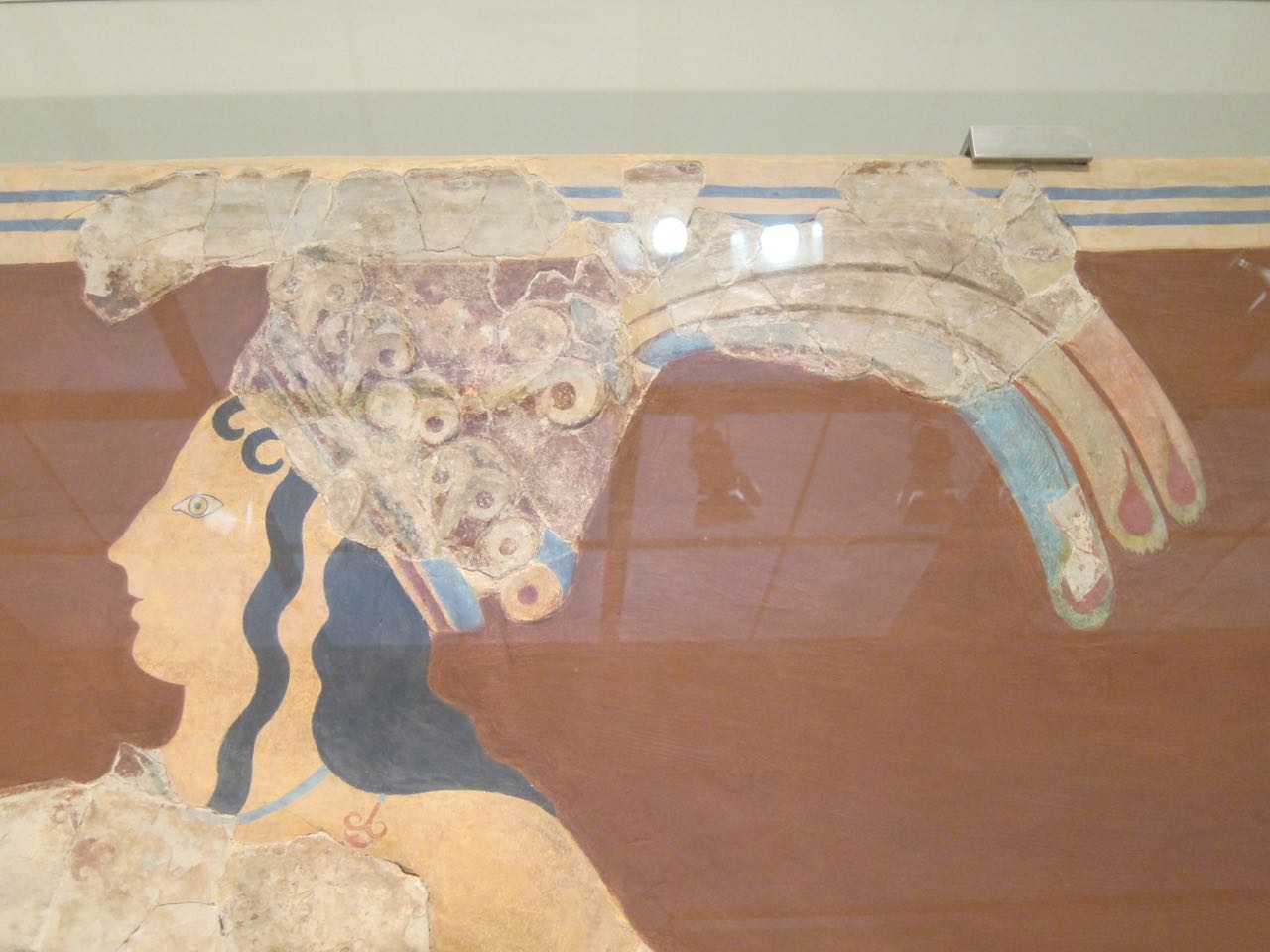
In fact, this famous fresco is, essentially, a 100% fabrication. In the Heraklion Archaeological Museum one can see how it was arrived at:
The "Prince of Lilies" at the Heraklion Archaeological Museum
It's actually a pastiche that includes three elements from what were probably three separate frescoes: a headdress, a torso, and a leg. All the connecting parts were drawn by Evans. Here is the close up of the headdress bit:
The face is the twentieth century drawing, and Sir Evans didn't get it right, because, as one of the archaeologists noted during our tour of Knossos, Minoan men didn't wear their hair in this style. The headdress might not even come from a human, but from a mythical creature like sphynx.
Now, although the Prince of the Lilies is a complete fabrication, it's a relatively harmless one. And even, on balance, it may do some good. Surely, this fanciful image has increased the enjoyment of the site for the 99 percent of visitors to Knossos, who don't know anything about the Minoans, nor care too much about them.
The second reconstruction is more consequential: the "Minoan Peace" (Pax Minoica). Sir Arthur assumed that there was little, if any, war on Crete during the Minoan period. Apparently, even though this idea was challenged subsequently, the majority of archaeologists continue to accept it in one or another form.
But one can accept the Minoan Peace only by ignoring copious and varied evidence pointing to the opposite conclusion.
First, the so-called Minoan "palaces", which should properly be called fortresses, were located on tops of hills. Living on a hill top is really inconvenient (if you have no modern transport), because you have a long way to travel to your fields, and you have to climb up a steep slope after a hard day's work. Usually people prefer not expend so much effort, unless there is a compelling reason to do so. This compelling reason is security.
The defensive advantages of hilltop location were especially apparent on our visit to Phaistos, which, unlike Knossos, is not surrounded by a town.
The hill of Phaistos. The palace ruins are just behind the summit.
The archaeological site of Phaistos. The hill-top palace dominated the agricultural fields surrounding the hill on which it was built.
There is a very strong macrohistorical pattern: people enjoying the secure environment tend to build villages and towns in the lowlands. When threatened, they move them to the hilltops (if there are hills, otherwise they move to river islands, into the marshes, or build walls, stockades, dig ditches and moats). This is the pattern we see from Peru to Italy. After the Roman Empire fell, and Pax Romana with it, Italians moved up to hilltop villages, like San Gimignano, that we enjoy so much visiting today.
On Crete, we see the same pattern: the Minoan palace of Gortyn was built on a hill, but when Gortyn became the Roman capital of Crete, the town moved down to the plain.
Second, we know that Minoan towns were periodically destroyed and burned down. You can still see the evidence of this today:
The black coloration of this limestone slab in Knossos is soot, resulting from a fire that destroyed the palace. Minoan palaces were all destroyed at least twice, in 1700 BCE and again 1450 BCE.
Third, there are hundreds of weapons, like swords and rapiers, exhibited in the Heraklion Archaeological Museum, which is clearly only a small fraction of those excavated, and those are a small fraction of weapons used during the Bronze Age. A rapier is only good for one thing: stabbing people.
Other signs of unsettled times include hoards, like this one:
and extensive storage magazines with huge jars:
Traditionally, these storage facilities were interpreted as signs of a redistributive palatial economy. But why would you establish a storage depot on a hill top? Furthermore, a quick calculation shows that this storage couldn't be used to address the needs of the general population.
There were roughly 400 jars each with 5 hektoliters of volume. That's 2,000 hektoliters. Assuming they stored grain, oil, and wine that's not even enough for 1000 annual rations (a person needs 2-3 hektoliters of just grain). That's not enough to feed the town of Knossos, which covered 70 ha and had an estimated population of 20,000 - 30,000.
This food (if food it was, we don't know for certain) could have been used for feasts. However, historical analogies suggest that food stored in fortresses was usually meant as emergency supply in case of siege. This is just a suggestion, but such a use would fit well with other evidence of warfare.
Although I have been beating up on Sir Arthur in this post, I actually sympathize with his position. He clearly loved the Minoan culture and wanted to think the best of it. And I also want human cultures to be peaceful. But we cannot get to the point where we will understand how to abolish wars by ignoring evidence of past warfare.



Blog Archive Comments 6 comments Comments originally published with this post. This archive is read-only.
Ross Hartshorn
One of the most interesting concepts your writing introduced me to was the "pacification of the past", whereby we make the past more peaceful (in our imagination) than it actually was. Of course, this is all still consistent with a society that has a once-in-a-century civil war, but in between is quite peaceful. Do we have skeletal or other evidence to indicate what the general rate of violent death was in the Minoan culture?
Sergey Sechiv
for the traditional sea-shore based societies in the tsunami-prone areas (see map http://www.mapsofworld.com/world-maps/tsunami-zones.html) the violence argument about the hilltop locations choices in not totally valid. I've read an article written by a real estate agent advising potential affluent buyers of the Caribbean island properties to consider that fact. And it is my observation, that mostly ALL multi-million sea-shore modern properties with their glass walls & doors are located on the hilltops for that reason.
Kirill Pankratov
I agree that the notion of the "peaceful Minoan" is not credible, but there is indeed a very rare feature which contributed to this fantasy: almost complete absence of militaristic images and themes in Minoan art, especially if compared to major contemporary civilizations: Middle Kingdom/early New Kingdom Egypt, Old Assyria, etc. Also, do relatively small hills, without significant defensive walls, provide enough protection? When security concerns were really overwhelming, people retreated to truly hard-to-reach places, such as peak settlements (Karphi, etc.) after the collapse of the Bronze age civilizations and rampant piracy and riding after 1200 BC. One argument against "peaceful Minoans" that I find more convincing is the Greek mythology of many centuries later, e.g. the legend of Minotaur and Theseus, reflecting the terror that early Mycenaeans felt before the Minoans dominating the Aegean world, and the Plato description of the "Atlantis" with its struggle between the "Athenians" (i.e. Mycenaeans) and "Atlanteans" (i.e. Minoans) and the total destruction of the latter by a natural cataclysm, likely mixing together the eruption of Thera around 1600 BC and Mycenaean "barbarian" invasion and destruction of the Minoan world around 1450 BC.
Mike Newsham
I think the traditional answer to that was that the Minoans were like the 19th Century British; their command of the sea let them have a relatively small army and peaceful home island. I believe this was undermined by new ideas that Crete was actually divided into valley-based plities that warred on each other. Though, just vague memories from popular articles.
Kirill Pankratov
I think it is unlikely that Minoans were a unified "empire" - the Crete topography, presence of many neighboring islands suggests against that. Yet inter-polity conflicts were likely not very intense. It could be similar to Classical Greece polities before the Peloponnese War - most of their conflicts were relatively short hoplite battles. And it doesn't have to contradict the first point you've mentioned, that they collectively felt secure against external invasions, being the dominant sea power in the eastern Mediterranean until mid-15 century BC.
steven johnson
There seem to be a few quantitative issue for the Minoan War hypothesis. If warfare between Minoan polities was the rule, why are burnt palaces concentrated in c. 1700 and 1450 BCE, as seems to be the case? It really seems more likely that individual fortresses would have fallen to other rivals. The victors wouldn't be burnt, but with the passing of time they might weaken and fall in their turn to another foe. Foreign conquest or a vast social rebellion seem at first glance better candidates for such a distribution of sacks over time. If the island of Crete was divided into independent statelets, would the hilltop fortress-palaces take up a significant portion of crop-bearing (and revenue bearing) land? The proportion of crops and revenue lost in larger polities seem likely to be relatively insignificant. but is it equally insignificant in a divided island? But this might be a misunderstanding of the archaeological evidence. Were these hilltop fortress-palaces or were they whole villages, even towns? It is hard to imagine any reason why farmers would trudge up hill to home after a hard day other than protection. But if the farmers were going to their homes elsewhere, that wouldn't matter. Is it possible the primary enemies of the lords on the hill tops were the peasants in the valley, with other lords standing as mere rivals, instead of enemies. Or even possible allies against the peasants? And that asks questions about the rapiers. Where are the remains of armor, shields, spears and arrows, which would seem equally necessary for warfare? Rapiers suggest large bodies of armed men, but could those be armed tax collectors, more police than soldiers?