Publication
Seshat: The Global History Databank
Authors
Peter Turchin, Rob Brennan, Thomas E. Currie, Kevin C. Feeney, Pieter François, Daniel Hoyer, J. G. Manning, Arkadiusz Marciniak, Daniel Mullins, Alessio Palmisano, Peter Peregrine, Edward A. L. Turner, Harvey Whitehouse
Abstract
The vast amount of knowledge about past human societies has not been systematically organized and, therefore, remains inaccessible for empirically testing theories about cultural evolution and historical dynamics. For example, what evolutionary mechanisms were involved in the transition from the small-scale, uncentralized societies, in which humans lived 10,000 years ago, to the large-scale societies with an extensive division of labor, great differentials in wealth and power, and elaborate governance structures of today? Why do modern states sometimes fail to meet the basic needs of their populations? Why do economies decline, or fail to grow? In this article, we describe the structure and uses of a massive databank of historical and archaeological information, Seshat: The Global History Databank. The data that we are currently entering in Seshat will allow us and others to test theories explaining how modern societies evolved from ancestral ones, and why modern societies vary so much in their capacity to satisfy their members’ basic human needs.
Journal
Cliodynamics: The Journal of Quantitative History and Cultural Evolution
Publication Details
Vol. 6 · No. 1
Cite This Publication
Peter Turchin, Rob Brennan, Thomas E. Currie, Kevin C. Feeney, Pieter François, Daniel Hoyer, J. G. Manning, Arkadiusz Marciniak, Daniel Mullins, Alessio Palmisano, Peter Peregrine, Edward A. L. Turner, Harvey Whitehouse. (2015). Seshat: The Global History Databank. Cliodynamics: The Journal of Quantitative History and Cultural Evolution, 6(1). https://doi.org/10.21237/c7clio6127917
Connections
Related work
Building the Seshat Ontology for a Global History Databank
This paper describes OWL ontology re-engineering from the wiki-based social science codebook (thesaurus) developed by the Seshat: Global History Databank. The ontology describes human history as a set of over 1500 time series variables and supports variable uncertainty, temporal scoping, annotations and bibliographic references. The ontology was developed to transition from traditional social science data collection and storage techniques to an RDF-based approach. RDF supports automated generation of high usability data entry and validation tools, data quality management, incorporation of facts from the web of data and management of the data curation lifecycle. This ontology re-engineering exercise identified several pitfalls in modelling social science codebooks with semantic web technologies; provided insights into the practical application of OWL to complex, real-world modelling challenges; and has enabled the construction of new, RDF-based tools to support the large-scale Seshat data curation effort. The Seshat ontology is an exemplar of a set of ontology design patterns for modelling uncertainty or temporal bounds in standard RDF. Thus the paper provides guidance for deploying RDF in the social sciences. Within Seshat, OWL-based data quality management will assure the data is suitable for statistical analysis. Publication of Seshat as high-quality, linked open data will enable other researchers to build on it.
Seshat: What Studying War Is Good for? A guest blog by Edward A. L. Turner.
Seshat: The Global History Databank is a game-changing database construction project that may reveal there is actually one thing war is good for: historical statistics.…
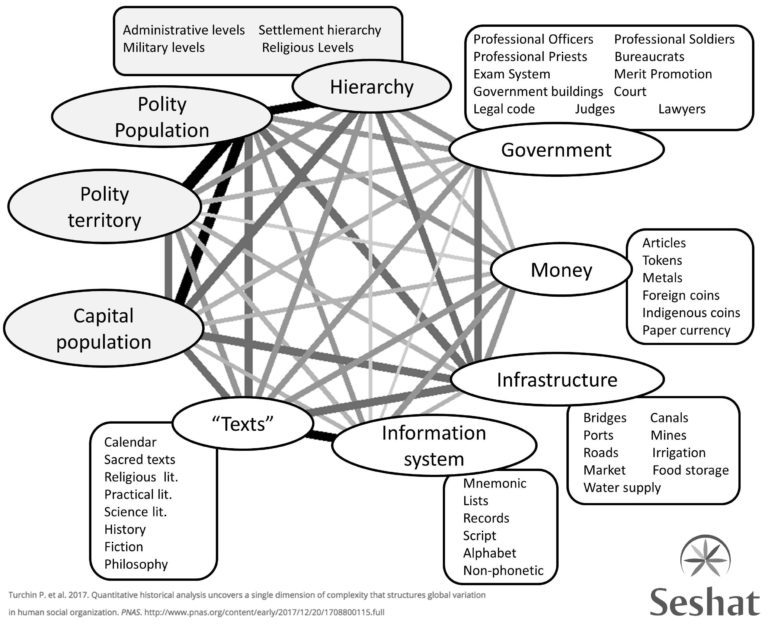
The first article to utilize the full power of the Seshat: Global History Databank
Philosophers, historians, and social scientists have proposed a multitude of different theories trying to explain the rise of huge complex human societies over the past few millennia.…
Expanding Scale of Human Society
Central to our mission at Science of the Noosphere is an exploration of the modern scientific perspective on how the noosphere evolved and expanded over time, from its origins in small paleolithic human groups to our emerging global civilization.…
Quantifying the Evolution of Social Complexity with Seshat: Global History Databank
I will present preliminary results of analyzing social complexity data in Seshat: Global History Databank. “Social complexity” has many dimensions, such as social scale, hierarchical organization, governance structures, provision of public goods, and capacity to cumulate and process information.…