Publication
Rise of the war machines: Charting the evolution of military technologies from the Neolithic to the Industrial Revolution
Authors
Peter Turchin, Daniel Hoyer, Andrey Korotayev, Nikolay Kradin, Sergey Nefedov, Gary Feinman, Jill Levine, Jenny Reddish, Enrico Cioni, Chelsea Thorpe, James S. Bennett, Pieter Francois, Harvey Whitehouse
Abstract
What have been the causes and consequences of technological evolution in world history? In particular, what propels innovation and diffusion of military technologies, details of which are comparatively well preserved and which are often seen as drivers of broad socio-cultural processes? Here we analyze the evolution of key military technologies in a sample of pre-industrial societies world-wide covering almost 10,000 years of history using Seshat: Global History Databank. We empirically test previously speculative theories that proposed world population size, connectivity between geographical areas of innovation and adoption, and critical enabling technological advances, such as iron metallurgy and horse riding, as central drivers of military technological evolution. We find that all of these factors are strong predictors of change in military technology, whereas state-level factors such as polity population, territorial size, or governance sophistication play no major role. We discuss how our approach can be extended to explore technological change more generally, and how our results carry important ramifications for understanding major drivers of evolution of social complexity.
Journal
PLOS ONE
Publication Details
Vol. 16 · No. 10 · pp. e0258161
Cite This Publication
Peter Turchin, Daniel Hoyer, Andrey Korotayev, Nikolay Kradin, Sergey Nefedov, Gary Feinman, Jill Levine, Jenny Reddish, Enrico Cioni, Chelsea Thorpe, James S. Bennett, Pieter Francois, Harvey Whitehouse. (2021). Rise of the war machines: Charting the evolution of military technologies from the Neolithic to the Industrial Revolution. PLOS ONE, 16(10), e0258161. https://doi.org/10.1371/journal.pone.0258161
Connections
Related work

End Times
Elites, Counter-Elites, and the Path of Political Disintegration
From the pioneering co-founder of cliodynamics, the groundbreaking new interdisciplinary science of history, a big-picture explanation for America's civil strife and its possible endgames Peter Turchin, one of the most interesting social scientists of our age, has infused the study of history with approaches and insights from other fields for more than a…
Figuring Out the Past: The 3,495 Vital Statistics that Explain World History
Discover the world records that define our history and jump headfirst into the past using scientific data that reveals accurate and insightful answers to life’s biggest questions.
What was history's biggest empire? Or the tallest building of the ancient world? What was the plumbing like in medieval Byzantium? The average wage in the Mughal Empire? Where did scientific writing first emerge? What was the bloodiest ever ritual human sacrifice? We are used to thinking about history in terms of stories. Yet we understand our own world…
Ages of Discord
A Structural-Demographic Analysis of American History
The real wage of a US worker today is less than it was 40 years ago—but there are four times as many multimillionaires. As inequality grows, the politics become more poisonous. Every year, more and more Americans go on shooting sprees, killing strangers and passers-by—and now, increasingly, representatives of the state. Troubling trends of this kind are…
Secular Cycles
Unraveling the dynamics of History through Demographic, Economic, and Political Shifts in Agrarian Societies
Many historical processes exhibit recurrent patterns of change Century-long periods of population expansion come before long periods of stagnation and decline; the dynamics of prices mirror population oscillations; and states go through strong expansionist phases followed by periods of state failure, endemic sociopolitical instability, and territorial…
War and Peace and War
Empires rise and fall, populations and economies boom and bust, world religions spread or wither…
In War and Peace and War, Peter Turchin uses his expertise in evolutionary biology to offer a bold new theory about the course of world history. Turchin argues that the key to the formation of an empire is a society’s capacity for collective action. He demonstrates that high levels of cooperation are found where people have to band together to fight off…
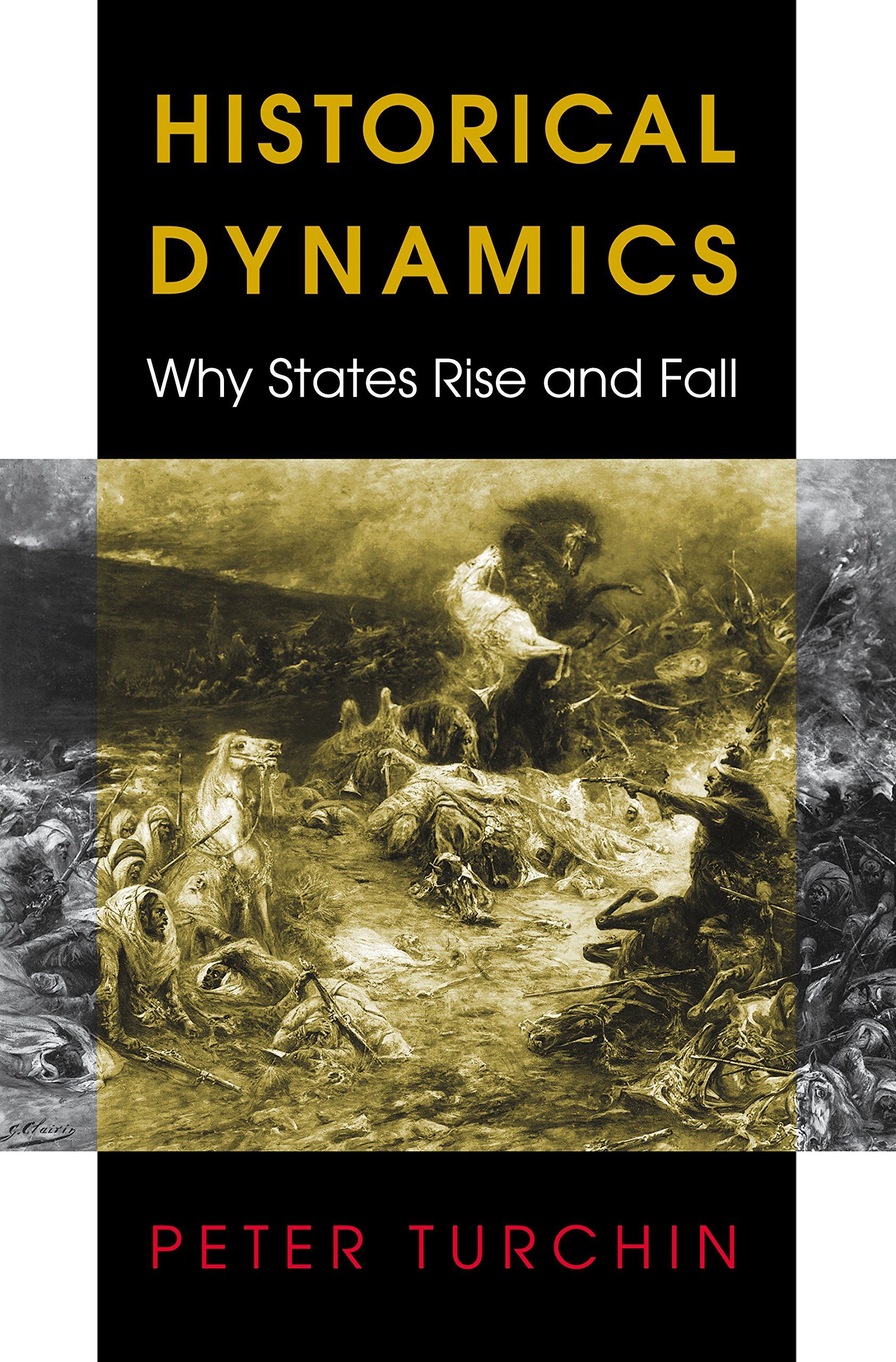
Historical Dynamics
A Synthetic Approach to Historical Expansions and Contractions through Mathematical Modeling and Empirical Analysis
Why States Rise and Fall Many historical processes are dynamic. Populations grow and decline. Empires expand and collapse. Religions spread and wither. Natural scientists have made great strides in understanding dynamical processes in the physical and biological worlds using a synthetic approach that combines mathematical modeling with statistical…