Publication
Multipath Forecasting: the Aftermath of the 2020 American Crisis
Authors
Peter Turchin
Abstract
Recent years have seen major political crises throughout the world. Most recently, the US was swept by a wave of protests, urban riots, and violent confrontations between left- and right-wing extremists. Understanding how future crises will unfold and assessing the resilience of different countries to various shocks is of foremost importance in averting the human costs of state breakdown and civil war. In a recent publication (Turchin et al. 2018) we proposed a novel transdisciplinary approach to modeling social breakdown, recovery, and resilience. This approach builds on recent breakthroughs in macrosocial dynamics (and specifically structural-demographic theory), statistical analysis of large-scale historical data, and dynamic modelling. Our main goal is to construct a series of probabilistic scenarios of social breakdown and recovery. We called this approach—similar to ensemble forecasting in weather prediction—multipath forecasting (MPF). In this article I develop a “prototype” of the MPF engine with the goal of illustrating the utility a fully developed version may have. I first apply the computational model to the period of American history from the beginning of the nineteenth to the end of the twentieth century, with the goal of parameterizing the model and testing it against data. Then I use the parameterized model to forecast the dynamics of instability in the USA beyond 2020 and illustrate how the MPF engine can be used to explore the effects of different policy interventions.
Journal
SocArXic Preprint
Cite This Publication
Peter Turchin. (2021). Multipath Forecasting: the Aftermath of the 2020 American Crisis. SocArXic Preprint.
Connections
Related work

End Times
Elites, Counter-Elites, and the Path of Political Disintegration
From the pioneering co-founder of cliodynamics, the groundbreaking new interdisciplinary science of history, a big-picture explanation for America's civil strife and its possible endgames Peter Turchin, one of the most interesting social scientists of our age, has infused the study of history with approaches and insights from other fields for more than a…
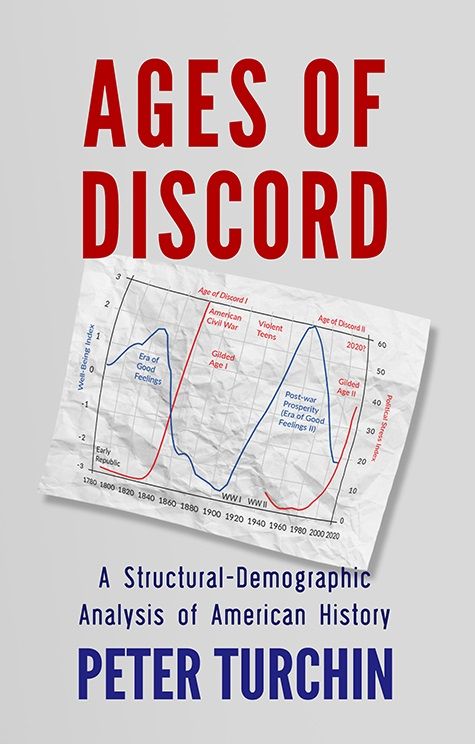
Ages of Discord
A Structural-Demographic Analysis of American History
The real wage of a US worker today is less than it was 40 years ago—but there are four times as many multimillionaires. As inequality grows, the politics become more poisonous. Every year, more and more Americans go on shooting sprees, killing strangers and passers-by—and now, increasingly, representatives of the state. Troubling trends of this kind are…

Secular Cycles
Unraveling the dynamics of History through Demographic, Economic, and Political Shifts in Agrarian Societies
Many historical processes exhibit recurrent patterns of change Century-long periods of population expansion come before long periods of stagnation and decline; the dynamics of prices mirror population oscillations; and states go through strong expansionist phases followed by periods of state failure, endemic sociopolitical instability, and territorial…
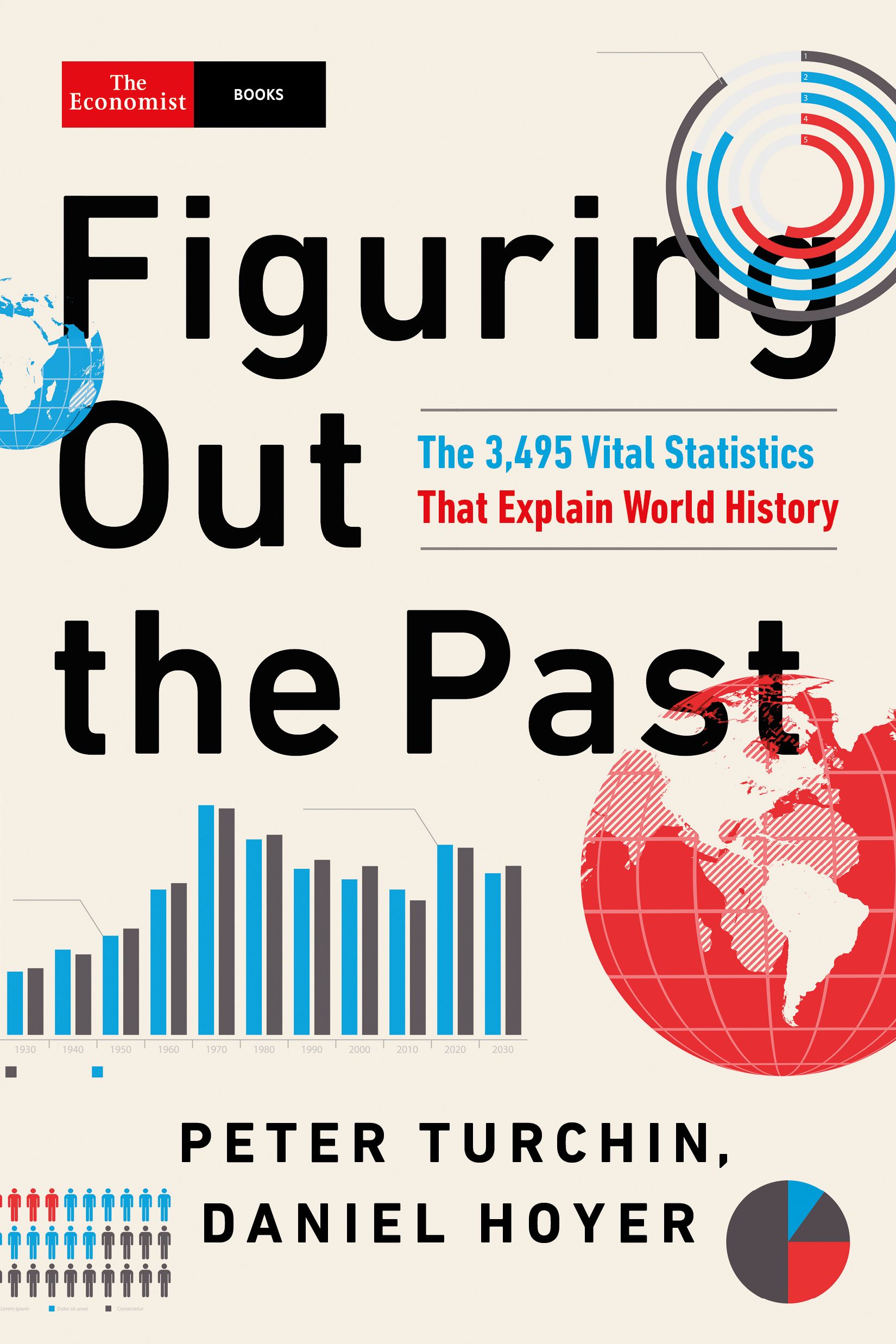
Figuring Out the Past: The 3,495 Vital Statistics that Explain World History
Discover the world records that define our history and jump headfirst into the past using scientific data that reveals accurate and insightful answers to life’s biggest questions.
What was history's biggest empire? Or the tallest building of the ancient world? What was the plumbing like in medieval Byzantium? The average wage in the Mughal Empire? Where did scientific writing first emerge? What was the bloodiest ever ritual human sacrifice? We are used to thinking about history in terms of stories. Yet we understand our own world…

Historical Dynamics
A Synthetic Approach to Historical Expansions and Contractions through Mathematical Modeling and Empirical Analysis
Why States Rise and Fall Many historical processes are dynamic. Populations grow and decline. Empires expand and collapse. Religions spread and wither. Natural scientists have made great strides in understanding dynamical processes in the physical and biological worlds using a synthetic approach that combines mathematical modeling with statistical…
CRISES AVERTED. How A Few Past Societies Found Adaptive Reforms in the Face of Structural-Demographic Crises
Historians and social scientists have long been preoccupied with understanding and documenting periods of crisis. Such emphasis is only growing, and becoming more pressing, as the world continues to face a number of interrelated stressors in the form of irreversible climate change, major ecological shocks and disease outbreaks, eruptions of military violence, economic disruptions and deepening inequalities, political polarization and unrest, the rise of authoritarian and nationalist regimes. Crises in these domains are not new, but have been recurrent features of past societies. Although these periods have typically led to massive loss of life, the failure of critical institutions, and even complete societal collapse, there are instances in the historical record of societies managing to turn the tide of crisis even as violence and social turmoil grow. Here, we focus on four such cases of crises mitigated with structural reforms revealed from our previous historical analyses: early Republican Rome, mid-19th century England and Russia, USA during the the late 20th to early 21st centuries. Utilizing structural demographic theory as a lens to explore these cases, we seek to expose the pressures that built up leading to crisis and the early signs of violent confrontation revealed by these societies, as well as to examine the conditions and key decisions made in the midst of this unrest that allowed these societies to turn the tide and enact significant structural adaptations. Our findings have clear relevance to understanding and navigating similar crises in contemporary societies.