Publication
Long-Term Population Cycles in Human Societies
Authors
Peter Turchin
Abstract
Human population dynamics are usually conceptualized as either boundless growth or growth to an equilibrium. The implicit assumption underlying these paradigms is that any feedback processes regulating population density, if they exist, operate on a fast-time-scale, and therefore we do not expect to observe population oscillations in human population numbers. This review asks, are population processes in historical and prehistorical human populations characterized by second-order feedback loops, that is, regulation involving lags? If yes, then the implications for forecasting future population change are obvious—what may appear as inexplicable, exogenously driven reverses in population trends may actually be a result of feedbacks operating with substantial time lags. This survey of a variety of historical and archeological data indicates that slow oscillations in population numbers, with periods of roughly two to three centuries, are observed in a number of world regions and historical periods. Next, a potential explanation for this pattern, the demographic-structural theory, is discussed. Finally, the implications of these results for global population forecasts is discussed.
Journal
Annals of the New York Academy of Sciences
Publication Details
Vol. 1162 · No. 1 · pp. 1-17
Cite This Publication
Peter Turchin. (2009). Long-Term Population Cycles in Human Societies. Annals of the New York Academy of Sciences, 1162(1), 1-17. https://doi.org/10.1111/j.1749-6632.2009.04447.x
Connections
Related work
Figuring Out the Past: The 3,495 Vital Statistics that Explain World History
Discover the world records that define our history and jump headfirst into the past using scientific data that reveals accurate and insightful answers to life’s biggest questions.
What was history's biggest empire? Or the tallest building of the ancient world? What was the plumbing like in medieval Byzantium? The average wage in the Mughal Empire? Where did scientific writing first emerge? What was the bloodiest ever ritual human sacrifice? We are used to thinking about history in terms of stories. Yet we understand our own world…
The Great Holocene Transformation
What Complexity Science Tells Us about the Evolution of Complex Societies
Why do the 99.9% of humanity live in large-scale societies organized as states? During the Holocene (the last 10,000 years), human societies have been transformed utterly: from small groups of nomadic foragers to our current interconnected world of large-scale societies organized as states. Population numbers, agricultural productivity, technological…
Ultrasociety
Cooperation is powerful
We organize ourselves into communities of hundreds of millions of individuals, inhabit every continent, and send people into space. Human beings are nature’s greatest team players. And the truly astounding thing is, we only started our steep climb to the top of the rankings—overtaking wasps, bees, termites and ants—in the last 10,000 years. Genetic…
War and Peace and War
Empires rise and fall, populations and economies boom and bust, world religions spread or wither…
In War and Peace and War, Peter Turchin uses his expertise in evolutionary biology to offer a bold new theory about the course of world history. Turchin argues that the key to the formation of an empire is a society’s capacity for collective action. He demonstrates that high levels of cooperation are found where people have to band together to fight off…
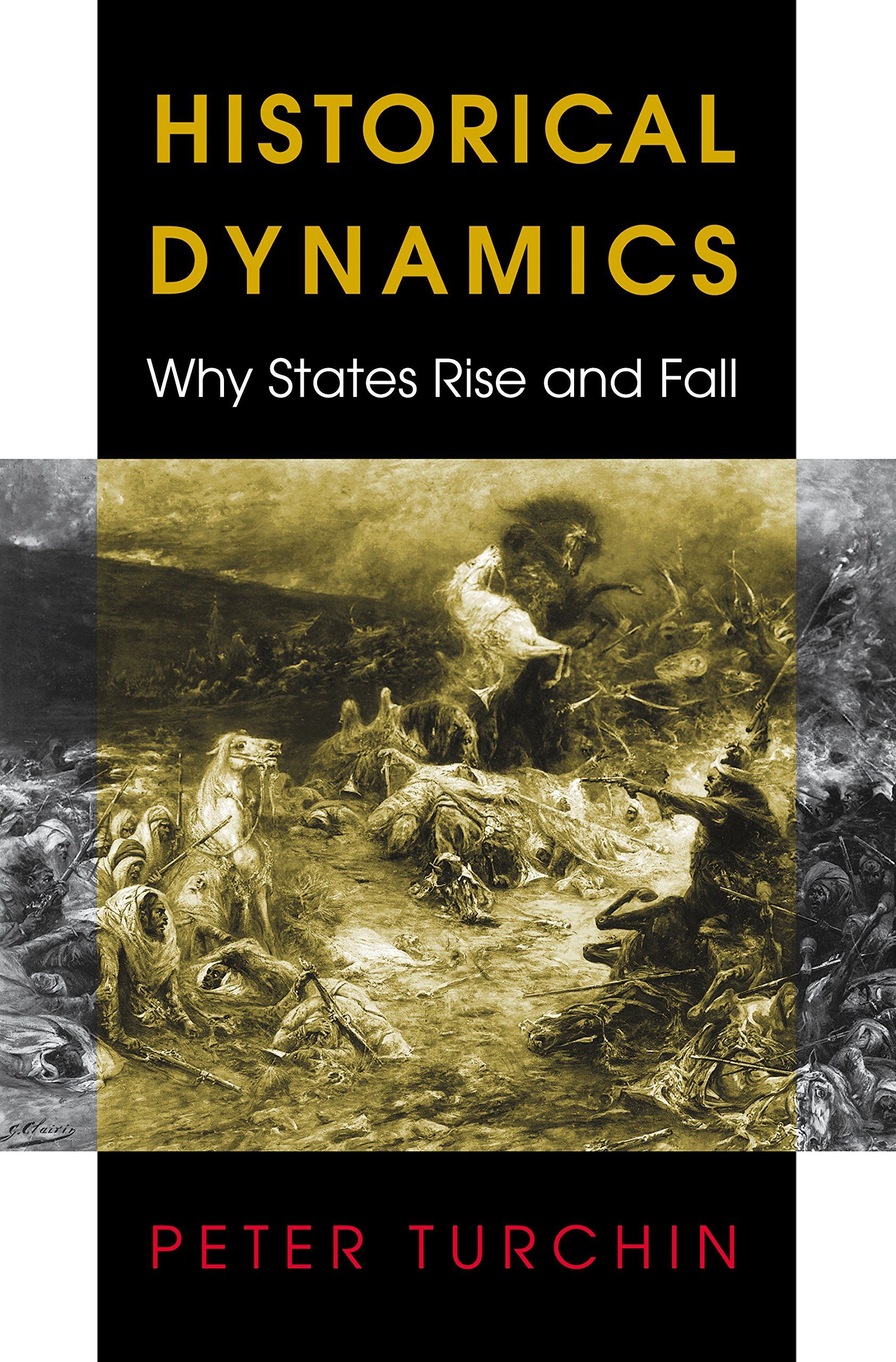
Historical Dynamics
A Synthetic Approach to Historical Expansions and Contractions through Mathematical Modeling and Empirical Analysis
Why States Rise and Fall Many historical processes are dynamic. Populations grow and decline. Empires expand and collapse. Religions spread and wither. Natural scientists have made great strides in understanding dynamical processes in the physical and biological worlds using a synthetic approach that combines mathematical modeling with statistical…
The Role of Ritual in the Evolution of Social Complexity: Five Predictions and a Drum Roll
In his “Reflections on the French Revolution,” the great Anglo-Irish statesman and philosopher Edmund Burke declared: “In history a great volume is unrolled for our instruction, drawing the materials of future wisdom from the past errors and infirmities of mankind.” But since the 18th century when Burke penned these lines, the “great volume” to which he referred has grown so vast through the accumulated discoveries and writings of historians, classicists, archaeologists and others that “unrolling” it has become practically unthinkable. Until now...The process of inferring general patterns in human history has usually meant cunningly plucking out facts to fit your argument—for instance ‘cherry picking’ historical events to lend credence to your judgments about the ‘errors’ of the past and your favored ‘prescriptions’ for the future. However flawed this methodology, alternative options were limited. Anybody seeking to use our accumulated experience of the past to predict likely patterns of history-making in the future has been limited by how much knowledge they could personally command, given the difficulties of accessing information, the limitations of brains (especially memory and processing power), and the shortness of scholars’ lifespans. To overcome these very human frailties, what has long been needed is a computerized database of global history in which patterns of correlations across space and time between variables of interest could be reliably tracked using statistical tools. Seshat: Global History Databank, a vast collection of information gleaned from the work of scholars who study the human past, will provide a new way of addressing this challenge (Seshat: Global History Databank 2015a). Seshat builds upon and radically expands a number of more established initiatives, including the Human Relation Area Files (HRAF; Human Relation Area Files 2015) and the Standard Cross-Cultural Sample (SCCS; Murdock and White 1969).