Publication
Explaining the rise of moralizing religions: a test of competing hypotheses using the Seshat Databank
Authors
Peter Turchin, Harvey Whitehouse, Jennifer Larson, Enrico Cioni, Jenny Reddish, Daniel Hoyer, Patrick E. Savage, R. Alan Covey, John Baines, Mark Altaweel, Eugene Anderson, Peter Bol, Eva Brandl, David M. Carballo, Gary Feinman, Andrey Korotayev, Nikolay Kradin, Jill D. Levine, Selin E. Nugent, Andrea Squitieri, Vesna Wallace & Pieter François
Abstract
The causes, consequences, and timing of the rise of moralizing religions in world history have been the focus of intense debate. Progress has been limited by the availability of quantitative data to test competing theories, by divergent ideas regarding both predictor and outcomes variables, and by differences of opinion over methodology. To address all these problems, we utilize Seshat: Global History Databank, a large storehouse of information designed to test theories concerning the evolutionary drivers of social complexity. In addition to the Big Gods hypothesis, which proposes that moralizing religion contributed to the success of increasingly large-scale complex societies, we consider the role of warfare, animal husbandry, and agricultural productivity in the rise of moralizing religions. Using a broad range of new measures of belief in moralizing supernatural punishment, we find strong support for previous research showing that such beliefs did not drive the rise of social complexity. By contrast, our analyses indicate that intergroup warfare, supported by resource availability, played a major role in the evolution of both social complexity and moralizing religions. Thus, the correlation between social complexity and moralizing religion seems to result from shared evolutionary drivers, rather than from direct causal relationships between these two variables.
Journal
Religion, Brain & Behavior
Publication Details
Vol. 13 · No. 2 · pp. 167-194
Cite This Publication
Peter Turchin, Harvey Whitehouse, Jennifer Larson, Enrico Cioni, Jenny Reddish, Daniel Hoyer, Patrick E. Savage, R. Alan Covey, John Baines, Mark Altaweel, Eugene Anderson, Peter Bol, Eva Brandl, David M. Carballo, Gary Feinman, Andrey Korotayev, Nikolay Kradin, Jill D. Levine, Selin E. Nugent, Andrea Squitieri, Vesna Wallace & Pieter François. (2022). Explaining the rise of moralizing religions: a test of competing hypotheses using the Seshat Databank. Religion, Brain & Behavior, 13(2), 167-194. https://doi.org/10.1080/2153599x.2022.2065345
Connections
Related work
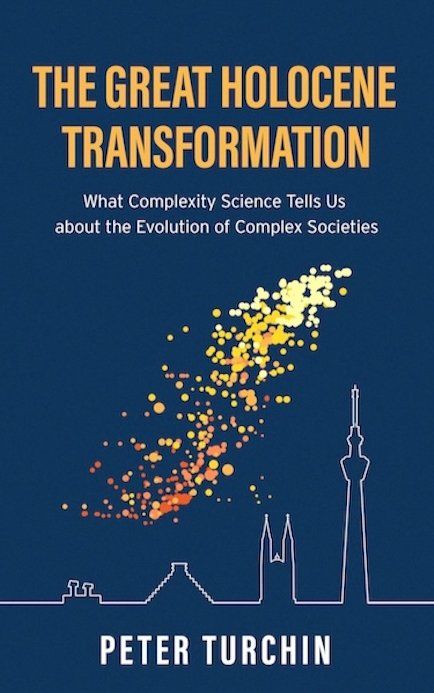
The Great Holocene Transformation
What Complexity Science Tells Us about the Evolution of Complex Societies
Why do the 99.9% of humanity live in large-scale societies organized as states? During the Holocene (the last 10,000 years), human societies have been transformed utterly: from small groups of nomadic foragers to our current interconnected world of large-scale societies organized as states. Population numbers, agricultural productivity, technological…
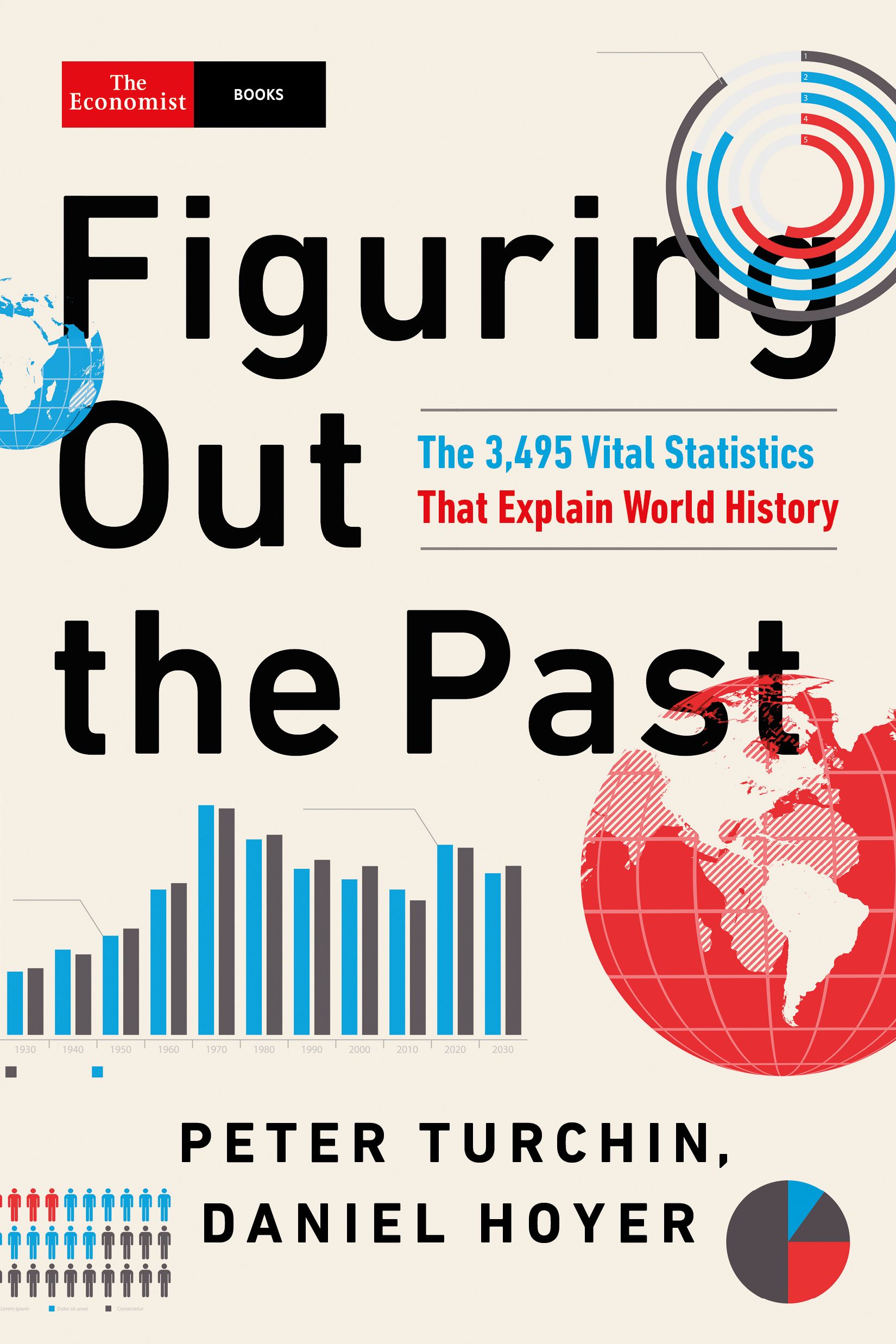
Figuring Out the Past: The 3,495 Vital Statistics that Explain World History
Discover the world records that define our history and jump headfirst into the past using scientific data that reveals accurate and insightful answers to life’s biggest questions.
What was history's biggest empire? Or the tallest building of the ancient world? What was the plumbing like in medieval Byzantium? The average wage in the Mughal Empire? Where did scientific writing first emerge? What was the bloodiest ever ritual human sacrifice? We are used to thinking about history in terms of stories. Yet we understand our own world…

Ultrasociety
Cooperation is powerful
We organize ourselves into communities of hundreds of millions of individuals, inhabit every continent, and send people into space. Human beings are nature’s greatest team players. And the truly astounding thing is, we only started our steep climb to the top of the rankings—overtaking wasps, bees, termites and ants—in the last 10,000 years. Genetic…
Soil Fertility Depletion is not a Credible Mechanism for Population Boom/Bust Cycles in Early Agricultural Societies
Soil fertility depletion presents a negative feedback mechanism that could have impacted early adopters of agriculture. We consider whether such feedback can lead to population cycles among early agriculturalists, such as the boom-and-bust patterns suggested by an increasing amount of evidence for Neolithic Europe. Using general mathematical arguments, we show that this is unlikely, due to the interplay of two factors. First, there is an important mathematical difference between biotic (i.e., logistic) and abiotic resource replenishment; soil nutrients are better modeled by the abiotic case, which leads to more stable dynamics. Second, under realistic conditions, the resource replenishment process operates on fast time scales compared to attainable population growth rates, reinforcing the tendency towards stable dynamics. Both these factors are relevant for early agricultural societies and imply that nutrient depletion is likely not the main contributing factor to boom-and-bust cycles observed in the archaeological record.
Explaining population booms and busts in Mid-Holocene Europe
Archaeological evidence suggests that the population dynamics of Mid-Holocene (Late Mesolithic to Initial Bronze Age, ca. 7000-3000 BCE) Europe are characterized by recurrent booms and busts of regional settlement and occupation density. These boom-bust patterns are documented in the temporal distribution of 14C dates and in archaeological settlement data from regional studies. We test two competing hypotheses attempting to explain these dynamics: climate forcing and social dynamics leading to inter-group conflict. Using the framework of spatially-explicit agent-based models, we translated these hypotheses into a suite of explicit computational models, derived quantitative predictions for population fluctuations, and compared these predictions to data. We demonstrate that climate variation during the European Mid-Holocene is unable to explain the quantitative features (average periodicities and amplitudes) of observed boom-bust dynamics. In contrast, scenarios with social dynamics encompassing density-dependent conflict produce population patterns with time scales and amplitudes similar to those observed in the data. These results suggest that social processes, including violent conflict, played a crucial role in the shaping of population dynamics of European Mid-Holocene societies.
Soil fertility depletion is not a credible mechanism for population boom/bust cycles in agricultural societies
Soil fertility depletion presents a negative feedback mechanism that could have impacted early adoptersof agriculture. In this paper, we present a formal mathematical analysis of the question whether such feedback can lead to population cycles in the context of early agriculturalists, such as the boom and bustpatterns suggested by an increasing amount of evidence for Neolithic Europe. We do this by considering candidates of second-order analytic models that capture dynamical interaction among farmers and soil fertility. Using general mathematical arguments, we show that under plausible conditions, the feedback between population growth and soil resource depletion is unlikely to lead to population cycles. This result is the consequence of two factors. First, there is an important mathematical difference between biotic (i.e. logistic) and abiotic resource replenishment; soil nutrients are better modelled by the abiotic case which leads to more stable dynamics. Second, under realistic conditions, the resource replenishment process has fast time-scales compared to attainable population growth rates, reinforcing the tendency of stable dynamics. Both of these factors play a role when considering early agricultural societies, and imply that nutrient depletion is not a credible mechanism for patterns of boom and bust cycles observed in the archaeological record. Published in Human Ecology