Publication
Building Nations after Conflict
Authors
Peter Turchin
Abstract
Political instability in collapsed or collapsing states is one of the greatest sources of human misery. Since the end of the cold war, withinstate conflicts, such as civil wars and separatist rebellions, have caused ten times more deaths than have wars between states. The indirect, non-military consequences of internal conflict — civilian casualties, refugees, wrecked economies, famine and disease — are orders of magnitude worse than the direct, military outcomes. In Fixing Failed States, former Afghan finance minister Ashraf Ghani and development-policy expert Clare Lockhart analyse why states crumble and propose a framework for rebuilding state capability.
Journal
Nature 453: 986-987
Cite This Publication
Peter Turchin. (2008). Building Nations after Conflict. Nature 453: 986-987.
Connections
Related work
End Times
Elites, Counter-Elites, and the Path of Political Disintegration
From the pioneering co-founder of cliodynamics, the groundbreaking new interdisciplinary science of history, a big-picture explanation for America's civil strife and its possible endgames Peter Turchin, one of the most interesting social scientists of our age, has infused the study of history with approaches and insights from other fields for more than a…
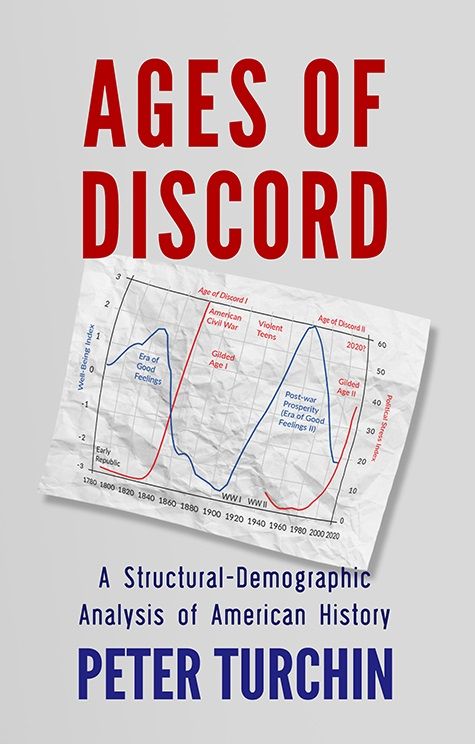
Ages of Discord
A Structural-Demographic Analysis of American History
The real wage of a US worker today is less than it was 40 years ago—but there are four times as many multimillionaires. As inequality grows, the politics become more poisonous. Every year, more and more Americans go on shooting sprees, killing strangers and passers-by—and now, increasingly, representatives of the state. Troubling trends of this kind are…
Secular Cycles
Unraveling the dynamics of History through Demographic, Economic, and Political Shifts in Agrarian Societies
Many historical processes exhibit recurrent patterns of change Century-long periods of population expansion come before long periods of stagnation and decline; the dynamics of prices mirror population oscillations; and states go through strong expansionist phases followed by periods of state failure, endemic sociopolitical instability, and territorial…
War and Peace and War
Empires rise and fall, populations and economies boom and bust, world religions spread or wither…
In War and Peace and War, Peter Turchin uses his expertise in evolutionary biology to offer a bold new theory about the course of world history. Turchin argues that the key to the formation of an empire is a society’s capacity for collective action. He demonstrates that high levels of cooperation are found where people have to band together to fight off…
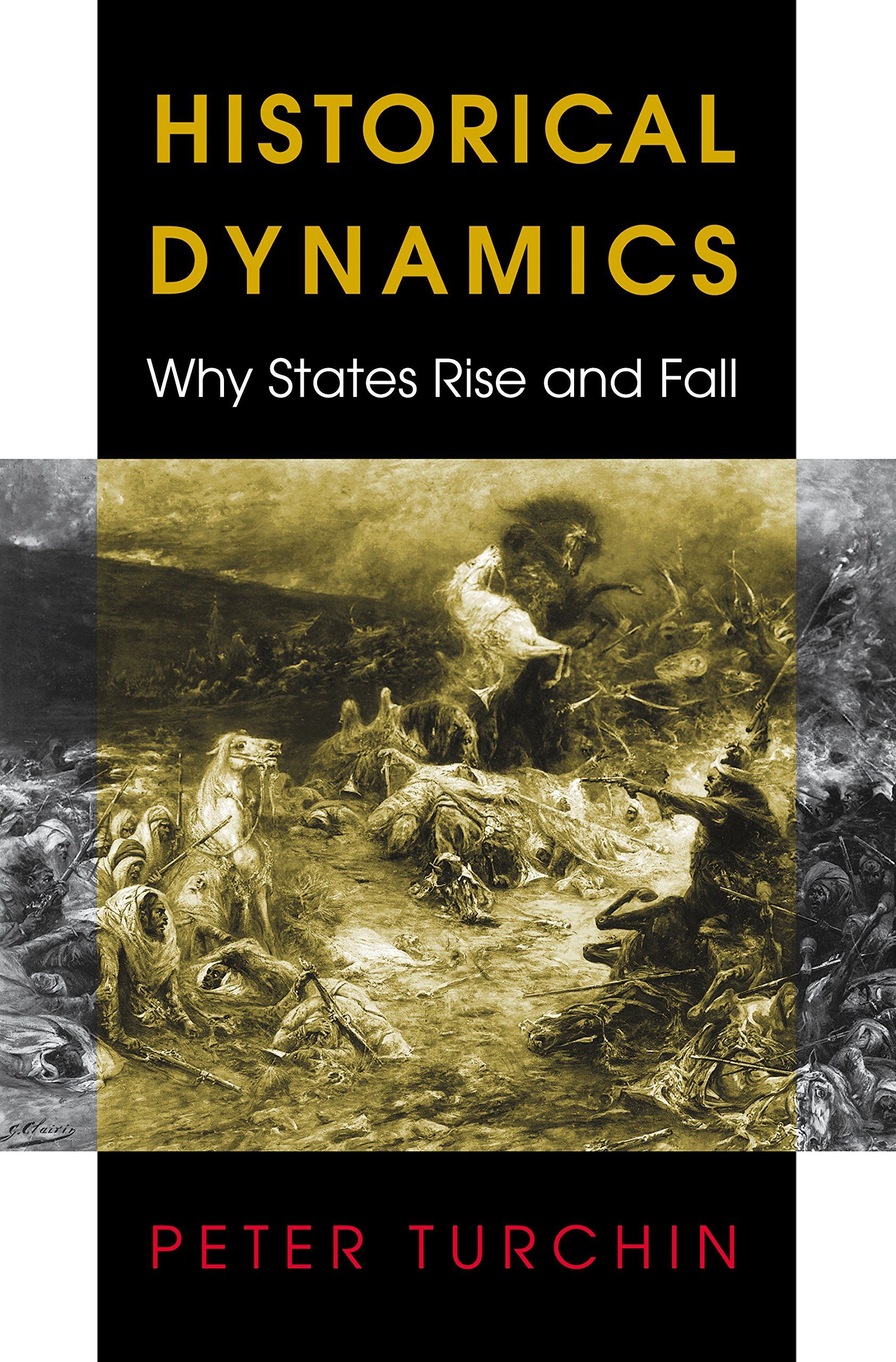
Historical Dynamics
A Synthetic Approach to Historical Expansions and Contractions through Mathematical Modeling and Empirical Analysis
Why States Rise and Fall Many historical processes are dynamic. Populations grow and decline. Empires expand and collapse. Religions spread and wither. Natural scientists have made great strides in understanding dynamical processes in the physical and biological worlds using a synthetic approach that combines mathematical modeling with statistical…
Empirically Testing and Refining Structural Demographic Theory: A Methodological Guide
Are human societies dynamical systems? Can they be studied—and, perhaps, to a degree predicted—with the methods of complexity science, such as agent-based models and big data analytics? If yes, what are the limits to prediction? A particularly challenging question is, can we forecast the dynamics of societal resilience and its obverse, sociopolitical unrest or even breakdown? So far efforts to predict onset of rebellions and civil wars using theory-free big data approaches have proved unsuccessful. An alternative approach, based on Structural-Demographic Theory (SDT), which integrates mechanism-based models with data and focuses on the dynamics of structural drivers for instability over the long-term (thus, requiring a historical approach), has shown better promise. Specifically, several recent studies utilizing the SDT framework have proven adept at predicting (or “retrodicting”) sociopolitical instability in c.20 past societies. It was also used in 2010 to successfully forecast outbreak of US instability 10 years in the future (in 2020). Collectively, this work is producing a growing body of evidence showcasing the ability of SDT-based approaches to uncover critical societal dynamics in the deep past as well as more contemporary cases. The next step in these efforts is to employ these insights towards the future. Here, we outline the SDT approach and document how it can be employed to explore the dynamics of any number of past and contemporary societies, appealing to researchers to pursue this line of research in as many cases as possible. The overall goal of this research is to empirically test SDT in a most rigorous way, using it to forecast coming periods of unrest. Because the theory is likely to fail in many ways, the second goal is to learn from these errors so that we can further refine the theory (or develop better-working alternatives). Specifically, we will learn: (1) how accurately (if at all) does the SDT framework predict future levels of sociopolitical instability (integrating incidence of antigovernment demonstrations, violent riots, and armed conflict); (2) What are the relative contributions of possible drivers of instability, including those proposed by SDT, as well as other theories, in explaining instability levels; and (3) are there key ‘leverage points’ that might help mitigate the negative consequences of instability?