Publication
A History of Possible Futures: Multipath Forecasting of Social Breakdown, Recovery, and Resilience
Authors
Peter Turchin, Nina Witoszek, Stefan Thurner, David, Garcia, Roger Griffin, Daniel Hoyer, Atle Midttun, James, Bennett, Knut Myrum Næss, Sergey Gavrilets
Abstract
Recent years have seen major political crises throughout the world, and foreign policy analysts nearly universally expect to see rising tensions within (and between) countries in the next 5–20 years. Being able to predict future crises and to assess the resilience of different countries to various shocks is of foremost importance in averting the potentially huge human costs of state collapse and civil war. The premise of this paper is that a transdisciplinary approach to forecasting social breakdown, recovery, and resilience is entirely feasible, as a result of recent breakthroughs in statistical analysis of large-scale historical data, the qualitative insights of historical and semiotic investigations, and agent-based models that translate between micro-dynamics of interacting individuals and the collective macro-level events emerging from these interactions. Our goal is to construct a series of probabilistic scenarios of social breakdown and recovery, based on historical crises and outcomes, which can aid the analysis of potential outcomes of future crises. We call this approach—similar in spirit to ensemble forecasting in weather prediction—multipath forecasting (MPF). This paper aims to set out the methodological premises and basic stages envisaged to realize this goal within a transdisciplinary research collaboration: first, the statistical analysis of a massive database of past instances of crisis to determine how actual outcomes (the severity of disruption and violence, the speed of resolution) depend on inputs (economic, political, and cultural factors); second, the encoding of these analytical insights into probabilistic, empirically informed computational models of societal breakdown and recovery—the MPF engine; third, testing the MPF engine to “predict” the trajectories and outcomes of another set of past social upheavals, which were not used in building the model. This “historical retrodiction” is an innovation that will allow us to further refine the MPF technology. Ultimately our vision is to use MPF to help write what we call “a history of possible futures,” in which the near- and medium-term paths of societies are probabilistically forecast.
Journal
Cliodynamics: The Journal of Quantitative History and Cultural Evolution
Publication Details
Vol. 9 · No. 2
Cite This Publication
Peter Turchin, Nina Witoszek, Stefan Thurner, David, Garcia, Roger Griffin, Daniel Hoyer, Atle Midttun, James, & Bennett, Knut Myrum Næss, Sergey Gavrilets. (2018). A History of Possible Futures: Multipath Forecasting of Social Breakdown, Recovery, and Resilience. Cliodynamics: The Journal of Quantitative History and Cultural Evolution, 9(2). https://doi.org/10.21237/c7clio9242078
Connections
Related work

The Great Holocene Transformation
What Complexity Science Tells Us about the Evolution of Complex Societies
Why do the 99.9% of humanity live in large-scale societies organized as states? During the Holocene (the last 10,000 years), human societies have been transformed utterly: from small groups of nomadic foragers to our current interconnected world of large-scale societies organized as states. Population numbers, agricultural productivity, technological…

End Times
Elites, Counter-Elites, and the Path of Political Disintegration
From the pioneering co-founder of cliodynamics, the groundbreaking new interdisciplinary science of history, a big-picture explanation for America's civil strife and its possible endgames Peter Turchin, one of the most interesting social scientists of our age, has infused the study of history with approaches and insights from other fields for more than a…
Figuring Out the Past: The 3,495 Vital Statistics that Explain World History
Discover the world records that define our history and jump headfirst into the past using scientific data that reveals accurate and insightful answers to life’s biggest questions.
What was history's biggest empire? Or the tallest building of the ancient world? What was the plumbing like in medieval Byzantium? The average wage in the Mughal Empire? Where did scientific writing first emerge? What was the bloodiest ever ritual human sacrifice? We are used to thinking about history in terms of stories. Yet we understand our own world…
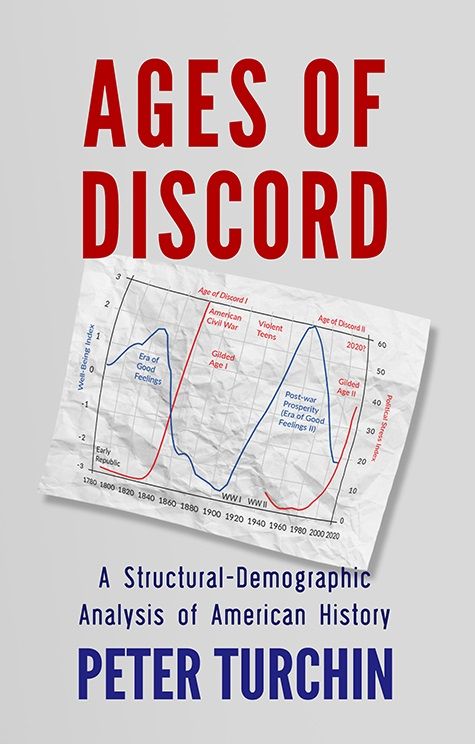
Ages of Discord
A Structural-Demographic Analysis of American History
The real wage of a US worker today is less than it was 40 years ago—but there are four times as many multimillionaires. As inequality grows, the politics become more poisonous. Every year, more and more Americans go on shooting sprees, killing strangers and passers-by—and now, increasingly, representatives of the state. Troubling trends of this kind are…

Ultrasociety
Cooperation is powerful
We organize ourselves into communities of hundreds of millions of individuals, inhabit every continent, and send people into space. Human beings are nature’s greatest team players. And the truly astounding thing is, we only started our steep climb to the top of the rankings—overtaking wasps, bees, termites and ants—in the last 10,000 years. Genetic…
Secular Cycles
Unraveling the dynamics of History through Demographic, Economic, and Political Shifts in Agrarian Societies
Many historical processes exhibit recurrent patterns of change Century-long periods of population expansion come before long periods of stagnation and decline; the dynamics of prices mirror population oscillations; and states go through strong expansionist phases followed by periods of state failure, endemic sociopolitical instability, and territorial…