The story behind Figuring Out the Past
by Peter Turchin and Daniel Hoyer
 Four years ago we got an interesting proposal from Ed Lake, the book acquisition editor at Profile Books. Profile has been publishing The Economist’s Pocket World in Figures series, an annually reissued statistical snapshot of the globe. Ed knew about our involvement with the Seshat project, and he wondered whether we would be interested in putting together a sort of World History in Figures.
Ed stressed that people have some sense of global history – most are probably familiar with their own country’s history, many know ‘key players’ like the Romans or Chinggis Khan’s vast Empire – but that few people outside of dedicated professional historians know much about the full sweep of our collective past. Most have an idea about the rise and fall of famous empires—the Romans, the Persians, the Chinese, the Incas. But how many people know about Jenné-Jenno, one of the oldest cities in Sub-Saharan Africa, located along the Middle Niger river (modern Mali)? And that despite sophisticated iron metallurgy, craft specializations, and high population densities, this ancient society lacks any sign of ruling elite or centralized administration? Or that the Dayak peoples in western Borneo aggressively expanded their territory during the 17th, 18th, and 19th centuries, also without an overarching centralized authority? Such “heterarchical” societies were quite common in the past, and yet they were organized on principles very different from the hierarchical empires in the history books.
The idea had a lot of appeal for us. Although Seshat was initially conceived as a historical data resource for testing scientific theories, we also wanted to make our work useful more broadly. Comparative history is an incredibly fascinating subject, because societies that occupied different regions of the globe in different historical eras were amazingly varied but also shared some general features. Both the huge diversity and a few general common themes are not just a subject of cocktail-party interest, but critical if we want to understand how human societies function and evolve. Historians have collaborated on a number of fascinating comparative studies, such as Rome versus China, or Ancient Egypt and Mesopotamia. But typically such comparisons focus on two, or a few, societies at a time. Is it possible to do comparative history “on steroids,” on a truly grand scale? We thought it would be a great project to try, and so we agreed. Little did we realize how massive such an undertaking would turn out to be, or how much we still had to learn…
As we explain in the volume’s introduction, we are used to thinking about the past in terms of stories of ‘great rulers’ or major battles, but we think of our own world largely through data: the key facts and figures that reveal how modern societies function. Yet history, especially comparative history, if the aim is to do it on a grand scale, must be quantitative as well. We cannot simply present a reader with a bookshelf of narrative histories covering different world regions and eras. To discipline our comparisons, we must seek answers to such questions as when? where? and how much? We also need a list of features that could serve as the common basis of comparing different societies. And then ask the same set of questions for all societies that we cover. We quickly realized through our discussions with Ed that we had a unique opportunity to spread the word on quantitative comparable history.
 We thought that our experience with Seshat would make this job a breeze. And it helped, to a certain extent, but we did not appreciate the difficulties we would have to overcome. The first difficulty was coming up with a list of features, or characteristics, of past societies that we would want to cover. The problem, of course, is that unlike modern societies, for which extensive statistics are available on almost any imaginable feature, for past societies we simply don’t know that much. So we agreed with the publisher that “nobody knows” is going to be an acceptable answer; in fact, identifying exactly what we don’t know, and for which societies we don’t know it, is just as important as uncovering what we do know. This exercise has already proven an invaluable spur to our current academic research, helping us come up with a new set of questions more tailored to the available evidence.
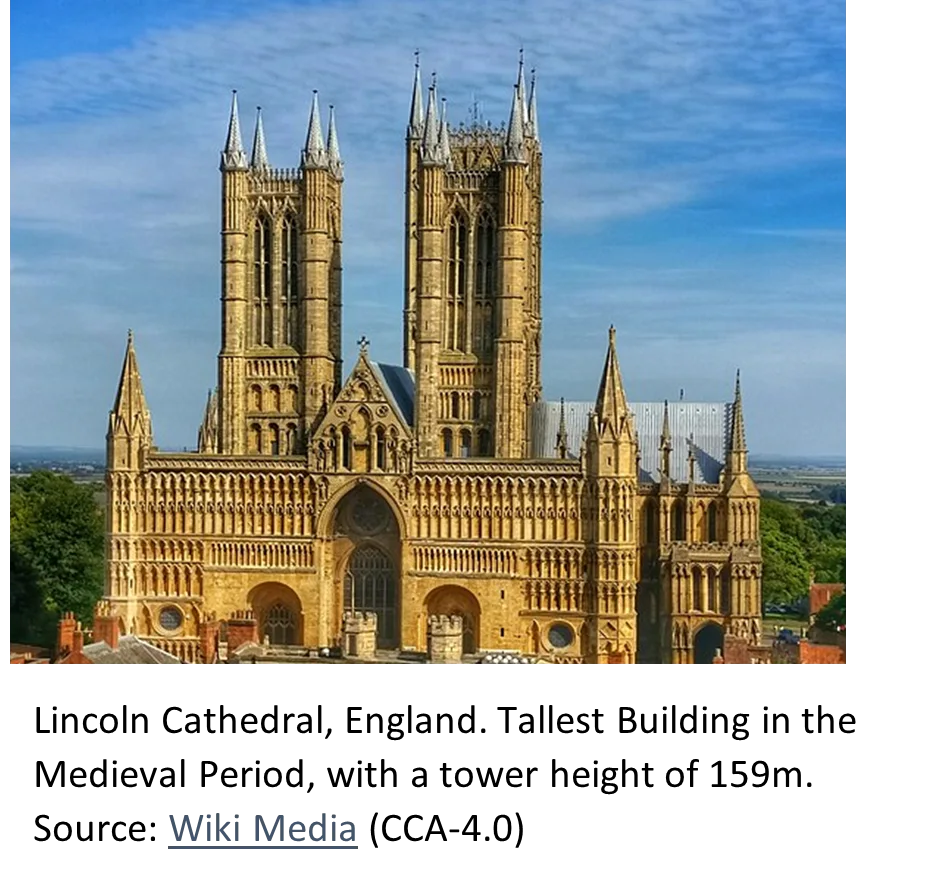
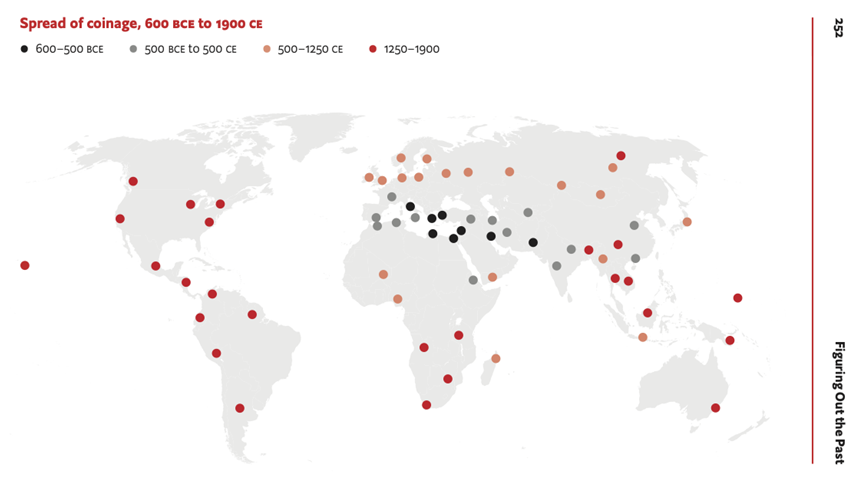
The second problem was selecting a set of societies to include in this survey. Pocket World in Figures covers 66 modern countries, which is a decent sample of the 193 sovereign states in the United Nations. But historical states number in the thousands, and we couldn’t include every one we have in our Databank (the resulting book would have been too big to carry out of the bookstore!). The book presents ‘deep dives’ into 57 separate societies from the ancient, medieval, early-modern, and modern periods, along with a host of rankings (the largest empire by territory ever, the tallest Medieval building, etc.) and a special section highlighting the adoption of important traits in each world region (like having a full-time bureaucracy, or the first use of paper currency, or the adoption of monogamy as widespread practice) along with some maps showing how key technologies like agriculture and gunpowder spread throughout the world.
We wanted to avoid the twin biases of Eurocentrism and “presentism” as best as we could, but also had to deal with the opposite problem: the farther you travel from a well-studied region, like Europe, and back into time, the less is known. So we had to balance these opposite demands. We undoubtedly made choices that could be criticized, but our main goal here is to present interesting and important facts about our shared past to those who are not familiar with thinking about these things.
The third problem was that checking the thousands of data that we gathered together turned out to be a monumental effort. We sadly underestimated the amount of labor that this job would require. A crew of our wonderful research assistants worked for months and then years, expert historians and archaeologists were very willing to share their knowledge with us, but with every data cleaning sweep we would find errors or omissions that the previous phase missed. There is no doubt more of such problems are still in the present volume, but eventually we had to stop and present the result of our labor to the world. So please be gentle when you find any mistakes—but also please share them with us. Our intent is that this will be just the first of several iterations, with each getting better and more accurate.
We also hope that the book will sell well. This may sound mercenary, but from the beginning we plowed the advance we got from Profile into supporting research assistants, and our intent is to use the future revenues for the same purpose. Thus, if the book sells well we will be able to, first, make future editions more accurate and complete. Next, we would like to expand the range of past societies we cover. Perhaps we would offer three volumes, on Ancient, Medieval, and Early Modern periods. And we would also like to expand the range of variables we cover.
Finally, we would be remiss if we didn’t thank the various people who have helped in making this volume possible. The first acknowledgment goes to Ed Lake, whose idea it was and who managed the whole process. Thanks are due to the very professional and incredibly patient production crew at Profile. We did stress their good will by sending them multiple corrected versions as we kept finding things to fix, but they came through with accommodating these changes. And they produced a very handsome book—one that would make a great Christmas present (hint, hint).
But our deepest gratitude is to our dedicated crew of research assistants – Jill Levine, Sal Wiltshire, Enrico Cioni, Jenny Reddish, Edward Turner, and Gregory Youmans – who did the real heavy-lifting, gathering and checking all of the data (and putting up with our constantly changing requests!). It is important to thank as well our collaborators who were extremely generous in providing their time and expertise reviewing the figures in this book: Mark Altaweel, Abel Alves, John Baines, Jim Bennett, David Carballo, Metin Cosgel, Alan Covey, Gary Feinman, Patrick Kirch, Andrey Korotayev, Nikolay Kradin, Jennifer Larson, John Miksic, Ruth Mostern, Alessio Palmisano, Peter Peregrine, Johannes Preiser-Kapeller, Katrinka Reinhart and many others.
Figuring Out the Past on Hachette BG
Figuring Out the Past in the Economist BookStore
Blog Archive Comments 14 comments Comments originally published with this post. This archive is read-only.
Mary Scriver
I love this stuff. In 1957 at Northwestern U theatre department I stepped into the context of Method acting. I was no good at it, but I could write. The idea is to inhabit the character by finding their parts inside yourself and understanding how they were shaped by their situation, their ecosystem, their culture, and the way their "spine" drove them through these things. Now I live between a white Belgian-origin irrigation town and a Blackfeet rez I've known since 1961. Black and white and yet -- both on the numinous East Slope of the Rockies. Gotta write about it.
Ross Hartshorn
Exciting! I had no idea such a thing was in the works! By the way, I don't know if it's ok for me to do this, but it looks like it's also available on Abe Books: https://www.abebooks.com/servlet/BookDetailsPL?bi=30776463604 I'm ordering my copy today.
Matthew
What database technology is Seshat built on? That would be a fascinating project to work on from the information architecture / IT perspective. Google-esk really.
Peter Turchin
We are looking for a database scientist: https://euraxess.ec.europa.eu/jobs/575608
Raymond Reichelt
On my wish list
Leeroy
@Matthew IIRC some of the team that worked on Seshat has gone on to release TerminusDB. Very exciting stuff, check out their blog at https://terminusdb.com/blog/
Igor Efimov
Why don't you have your books in audio format? I want to buy this book, but prefer to listen.
Matthew
How does one get into complexity studies? I have an MSc in molecular biology but sort of lost interest because I found the field to be reductionist to the point of diminishing returns. I’m a self taught programmer and have an interest in value investing. All this points me to research in complex systems, but I feel like the field is not that main stream as of yet. Terminus looks like an interesting graph database. I’ve played around with datomic which is an immutable graph database with a prolog like query engine built by the Clojure community (a LISP). Lol, terminus.
Lari Tiller Howell
Your Seshat data link doesn't work. I got there through http://seshatdatabank.info/
Lari Tiller Howell
I got there through http://seshatdatabank.info/ Your Seshat data link doesn't work.
Peter Turchin
@Lari Tiller Howell: thanks, fixed
Mateus Dantas
Fantastic job, looking forward to this. Just wanted to say also that in more subjective terms I am finding your Ultrasociety book very uplifting, especially in terms of restoring faith in humanity. I am sure you get that a lot too.
Mateus Dantas
I was looking at the index of the book and one topic I found lacking was the societal role of women (e.g. literacy, independence), the closest I found was monogamy, which could indicate something indirectly. I was reading recently about Sparta and was very curious to the implications of female relevance in past societies.
Bill Gould
Hi Peter. Looking forward to reading your books. I have an idea about Jenné-Jenno. Did they have a written language? If no then we’re they picture thinkers? Jordan Peterson clued me into different states of consciousness with his conversations with an indigenous artist in Canada. Might be relevant to lack of elites in ancient cultures. Is written language the key or possibly money?