Thanks Peter for bringing this issue to your blog readers.
Here are a couple of important points which you and/or your readers should address when evaluating Richard Wrangham’s hypothesis that the control of fire and subsequent consumption of cooked tubers represented an evolutionary advantage that led to the natural selection of a larger brain mass relative to body mass in hominids, a process known as encephalization:- The metabolic cost of the human brain is 9 times (11.2 watts/kg) greater than average whole body metabolic rate (1.25 watts/kg) at rest (1). Accordingly, in modern humans with an encephalization index of 4.9 versus an encephalization index of 1.9 in non-human anthropoids (2), the fully encephalized modern human brain utilizes 20-25% of the total resting metabolic rate (RMR) whereas in other primates, this value is 8-9% (3). So, indeed the evolution of a large brain relative to body mass in hominid’s represents an energetically expensive process. And your question as to where did the increased energy come from to allow for the natural selection of our large, metabolically active brain is a good one, but certainly not the only relevant question. Let me address the energy question first.
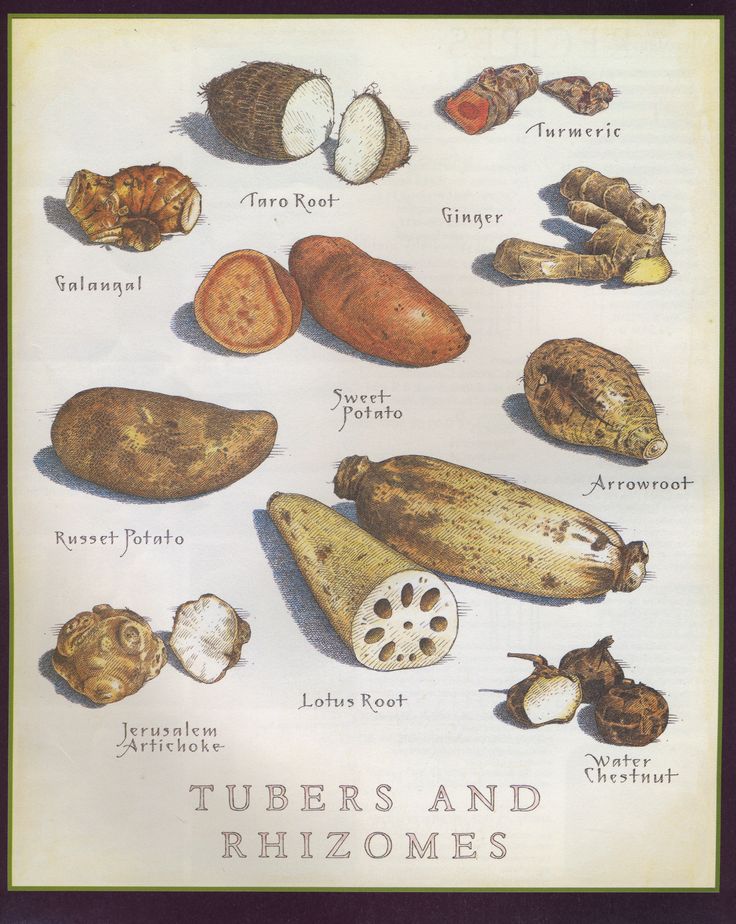
- Below is Table 1 showing the energy density of the most likely foods which may have been available to our hominid ancestors during the time period which the genus Homo arose in Africa 2.0 to 2.3 million years ago (MYA) and during which increased encephalization began to occur (4). As you can see from the Table 1, far and away, fatty animal foods are the most concentrated energy sources whereas wild tubers and roots are the least energetically dense of all the foods listed (4). This situation remains true for modern, domesticated equivalents of wild tubers and roots as demonstrated in the Table 2 (5).
| Food | (kcal/100 g) |
| African ruminant subcutaneous fat | 745 |
| Ruminant marrow | 488 |
| Mixed, wild nuts | 306 |
| African ruminant liver | 159 |
| Mixed, edible wild plant foods | 129 |
| African ruminant brain | 126 |
| African freshwater fish | 119 |
| African ruminant muscle | 113 |
| Mixed, wild tubers/roots | 96 |
Source: Google images
Table 2. Energy density of common modern tuber and root vegetables (5)| Modern Root Vegetables | (kcal/100 g) |
| Cassava (manioc, tapioca), cooked | 160 |
| Taro, cooked | 142 |
| Yam, baked | 116 |
| Potato, baked | 109 |
| Sweet potato, baked | 103 |
| Parsnips | 81 |
| Jerusalem artichoke | 76 |
| Chicory | 73 |
| Burdock root | 72 |
| Carrots, raw | 45 |
| Beet, cooked | 44 |
| Celeriac, cooked | 42 |
| Turnip, cooked | 27 |
| Mean | 83.8 |
One of the crucial elements of the Wrangham Hypothesis is the assumption that the regular controlled (I bold and underlie this term for emphasis later on) use of fire allowed for the consumption of a formerly untapped food resource (underground roots and tubers), which in turn represented the energy source necessary (1,4) for the selection of a large, metabolically active brain.
A huge, logical hurdle to overcome for believers in the Wrangham Hypothesis is that tubers actually are not energetically dense, but rather are the least energetically dense of all foods available to our hominid ancestors during the period when encephalization occurred 2.3 to 2.0 MYA. This evidence is clearly demonstrated in Table 1. Further, cooking of starchy tubers yields caloric density values slightly greater (5-10%) than their raw values because of the removal of water, but lower than most than raw wild plant foods (Table 2) which have always been available to our African hominid ancestors, prior to increased encephalization.
A final flaw in the Wrangham Hypothesis is the failure to consider other nutritional constraints to encephalization in all mammals besides energy density. Clearly large brains per body mass convey multiple evolutionary advantages in cognition, environmental awareness and strategic advantages to increased reproductive success while avoiding mortality from all causes. Yet the evolution of large brains requires other important known nutritional factors.
The synthesis of all mammalian brain and nervous tissue requires at least two major fatty acid precursor molecules (arachidonic acid, 20:4n6 and docosahexanoic acid, 22:6n3). Whether a mouse, elephant or primate, regardless of encephalization indices, all brain and nervous tissue have invariant concentrations of these fatty acids (4, 9-11). Hence, a physiologic bottleneck has occurred in all mammals that we have unfortunately inherited from the very first mammals and constrains evolution of large, complex brains.
This evolutionary bottleneck necessary for increased encephalization in all mammals occurs in the liver. All mammals have extremely limited, or no ability, to convert plant precursor fatty acids fatty acids (linoleic acid 18:2 n6 to arachidonic acid, 20:4 n6) and (alpha linoleic acid 18:3 n3 to docosahexanoic acid, 22:6 n3) which are the necessary physiologic elements for the synthesis of brain tissue (4, 8-11). Unfortunately, the Wrangham hypothesis does not address or is completely unaware of this evidence. Tubers and roots contain no preformed arachidonic acid (AA) or docosahexanoic acid (DHA) required for the evolutionary increase in the encephalization index observed in homids.
The scavenged, de-fleshed carcasses of African ruminants represents a concentrated energy source (marrow) needed for increased encephalization, and the skull with its brain contents of these scavenged carcasses represents the most concentrated terrestrial source of DHA (4).
References:
- Aiello LC, Wheeler P: The expensive tissue hypothesis. Curr Anthropol 1995;36:199-222.
- Martin RD. Primate Origins and Evolution. London: Chapman & Hall, 1990
- Mink JW, Blumenschine RJ, Adams DB: Ratio of central nervous system to body metabolism in vertebrates: its constancy and functional basis. Am J Physiol 1981;241:R203-R212.
- Cordain L, Watkins BA, Mann NJ. Fatty acid composition and energy density of foods available to African hominids: evolutionary implications for human brain development. World Review of Nutrition and Dietetics, 2001, 90:144-161.
- Cordain L. Potatoes should stay below ground. In: Cordain L, The Paleo Answer, John Wiley & Sons, New York, NY, 2012.
- Cordain, L., Gotshall, R.W. and Eaton, S.B. (1998). Physical activity, energy expenditure and fitness: an evolutionary perspective. International Journal of Sports Medicine, 19(5): 328-335.
- Leonard W.R., Robertson M.L.: Nutritional requirements and human evolution: a bioenergetics model. Am J Hum Biol 4: 179-195, 1992.
- Leonard W.R., Robertson M.L.: Evolutionary perspectives on human nutrition: the influence of brain and body size on diet and metabolism. Am J Hum Biol 6: 77-88, 1994.
- Crawford MA, Sinclair AJ: The long chain metabolites of linoleic and linolenic acids in liver and brains of herbivores and carnivores. Comp Biochem Physiol 1976;54B:395-401.
- Crawford MA, Bloom M, Broadhurst CL, Schmidt WF, Cunnane SC, Galli C, Gehbremeskel K, Linseisen F, Lloyd-Smith J, Parkington J: Evidence for the unique function of docosahexaenoic acid during the evolution of the modern hominid brain. Lipids 1999;34:s39-s47.
- Crawford MA: The role of dietary fatty acids in biology: their place in the evolution of the human brain. Nutr Rev 1992;50:3-11.
Blog Archive Comments 11 comments Comments originally published with this post. This archive is read-only.
Gene Anderson
All true, fair, and important, but the counter is that Wrangham didn't talk about only tubers, and fire makes food of all sorts more available--including meat. Cooking kills the parasites, for one thing. The main thing wrong with this post, though, is that Cordain is skipping over the calories per acre question. There is only so much meat out there, even in Africa. Plant biomass is always going to be much greater. The modern human diet in virtually all groups studied is 10--20% meat (except in environments like the Arctic, far from anywhere people evolved). We can safely infer that early hominins did not ignore all those berries, fruits, shoots, nuts, etc. that abound in Africa as elsewhere. Early humans were highly opportunistic omnivores. Cooking helped them. More to the point, though, is that people like to be fire-followers, and all human groups that live in burnable environments burn said environments to open them up and produce more food that people can eat. It's a lot easier to burn brush, and to learn how to burn brush, than to cook. I have always assumed that people learned to use and control fire via that route. They started off following natural fires and gradually learned to control the fires. Cooking came later.
Cramster
Please provide your estimates of what you mean by " only so much meat out there". As late as the 1800s for example, there were a estimated 30 to 60 million buffalo in just North America. At the end of the Paleo the Entire world population is esstimated to have been 6 to 8 million.
Richard
While the fatty acid argument has merit, the caloric density argument doesn't hold water. If tubers are less calorically dense than meat, can not humans just eat a bigger volume of tubers (as humans for ages have done)? It seems to me that for hunter-gatherers, getting a bunch of tubers likely usually is much easier than getting even a smaller volume of meat.
al loomis
ARMED WITH ONLY A ATTENBOROUGH DOCO, MAY I INSERT THAT CHIMPS HUNT FOR MEAT?
admin
Yes, that's well documented. Colobus monkeys are the main prey.
admin
Hi Gene and Richard, I think you hit the issue on the head. I'll try to come up with a more detailed response in the next day or two, and post it on the blog.
Alessio
It's not all about calories, it's more about nutrients, key nutrients that lack in tubers and also in vegetables and fruits, they were backup food when meat was not avaialble. The calories stuff drives me nuts because it's only one small part of the issue. Of course we tend to simplify, but oversimplification means considering one variable inside a billions variables equation. We are far from being calorimeters that burn all the stuff we throw inside, we are very complex beings and different macro and micro nutrients in sinergy drive different methabolic patways. And nature through evolution selected our gut and stomach for a certain mass of food at time with a certain nutrient density, you can't eat tons of tubers and vegetables hoping to get all that we need, also because we don't absorbe much from them.since they not only lack of key molecules, but the others are mostly binded with antinutrients that are only partially broken by cooking. The cooking claim that made us human is half bogus. There are some hints: the slope of the encephalization curve was already set off before the domesticazion of fire. Second, with the advent of agriculture we had everything cooked, but cereal grains and other nutritionally poor stuff that replaced meat made us strikingly weak, short and sick and our brain shrinked. Hunter gatherers that hardly rely on tubers like Inuit were much healthier and stronger than us, and that means that they are not a key food for us but rather more a backup food. Actually it seems that Nature provides the right balance between predators and preys and starvation is not the norm, until we human beings manage to disrupt every mechanism.Some studied "modern" hunter gatherers live in a backup land confined by our civilization and the fact that they highly rely on tubers and stay relatively healthy compared to us doesn't necessarily mean that they have the "best" diet but for me it means that after all we have a certain flexibility to survive and such flexibility was most probably the key of our success, but everything is not black and white and there are many shades of gray. The problem for me is that nutritionists lack of evolutionary education and anthropologists lack of nutritional education, it takes an higher perspective to analyze data. If you lack of the key principles of nutrition you come out with claiming that it's all about calorie totally ignoring the role of DHA, AA, creatine, carnitine, carnosine, vitamin B12, eme-iron etc. etc. that make vegan diet a nutritional disaster. Fortunately Dr. Cordain seems to own both of the skills and though some things are still controversial, he has a very high perspective of the issue to collect the pieces of the puzzle.
admin
Alessio, thank you for your comment. However, as someone who spent the first half of my scientific life studying population cycles in animals, I should point out that periodic starvation is very much present in nature. It's a mistake to think that ecological interactions are so well balanced that they are always in equilibrium. In fact, cycles, chaos, and exogenous perturbations, some catastrophic, are the rule, rather than exception.
Alessio
CJ Hunt, the reporter of The Perfect Human Diet, did some interesting interviews with some anthropologists like Mannini and others and it came out that it's not discounted that humans had been limping around eating whatever they found. I think that it's very likely that some periods of starvation occured, but pointing out that backup food poorly nutritional made the major amount of our diet it's not consistent neither with the many pieces of the puzzle nor with the evidence (whenever you look at the vegan populations like Indians and vegan people around the world you see a strikingly lack of nourishment, and not only from raw vegans, also from the cooking vegans as well. And archelogical records clearly shows an astonishing drop of health condition from a meat based diet to a cereal grains based one where everything was well cooked since you can't eat grains raw. And they were the alleged healthy whole grains I guess since the modern way to refine and process them had not been invented yet. Further, when a lion is through a period of starvation, it doesn't make a non species appropriate food as a staple, because its physiology can't handle alien food, as the evidence coming from our digestive tract (short gut compared to the other primates), enzymatic wealth (very poor compared to herbivores and granivores) is closer to a pure carnivore than a bird or a cow, somewhere between a chimp and a feline, a great hint to expect that meat itself played a huge role in our evolutionary path.
Alessio
With our amazing ingenuity we managed to make edible an otherwise totally digestible food for our species, but at the same time it will never be able to substitute the food we are actually shaped to eat and that made us human. You can't get DHA, creatine, carnitine, taurine, B12, eme-iron, etc.. from the alleged plant based diet, because some of such key nutrients totally lack in plants and some others are poorly bioavailable even if they are cooked. If it's true that with cooking you can extract some nutrients breaking down antinutrients, it's also true that you're going to lose some other key nutrients. At least it's advisable to cook some stuff and eating raw others. You can't take enough vitamin C if you cook everything for example and DHA is going to be degradated at relatively low temperatures, suggesting that well cooked meat should at least be alterned with bloody steaks.
Anonymous
There is actually good evidence that the body can synthesize the required fatty acids endogenously, and this conversion is actually fairly tightly regulated. The brains reliance on glucose as energy seems to be a sign that it was humans access to glucose that accounted for rapid brain development. If there is a lack of exogenous glucose, then the body will break down muscle tissue and fat stores to give the brain glucose via ketones and gluconeogenisis. This blogger does a very good job of providing an argument against the necessity of exogenous DHA and other fatty acids. http://tanyewwei.com/blog/dha/#endogenous-dha-synthesis