As is well known, all major forecasters confidently predicted that Hillary Clinton would win the presidential elections of 2016. On the morning of the election day (November 8th 2016) at 10:41 am, when a number of American voters had already cast their votes, FiveThirtyEight’s Nate Silver still predicted that Hillary Clinton had a 71% chance to win. Others had predicted Clinton to win with even higher probability, between 85% to 99%.
A new article, just published by Cliodynamics: The Journal of Quantitative History and Cultural Evolution, brings up a little known fact that should have caused the statisticians take a second look at their predictive models.
There are many reasons why people lie to pollsters. In fact, people regularly lie to themselves. What we need is a more reliable predictor of likes and dislikes, than directly asking people. We need a good “proxy.”
In the article Trends in first names foreshadowed Hillary Clinton’s electoral defeat Stefano Ghirlanda argues that one such proxy is provided by the naming patterns. He writes, “naming decisions are not entirely rational, and can be influenced by seemingly extraneous factors of which parents are not aware.” He then proceeds to show “that trends in first names foreshadowed, in the USA, the defeat of Democratic Party candidate Hillary Clinton in the 2016 presidential election.”
The idea is quite simple. Parents tend to name their children after people they admire. They certainly avoid names associated with those they dislike. When was the last time you met anybody born after 1945 whose first name was “Adolf”?
Ghirlanda analyzed the data on first names of babies issued a Social Security number (which is, essentially, all the babies born in the US). Here’s the pattern that he saw when he looked at the dynamics of the name “Hillary”:
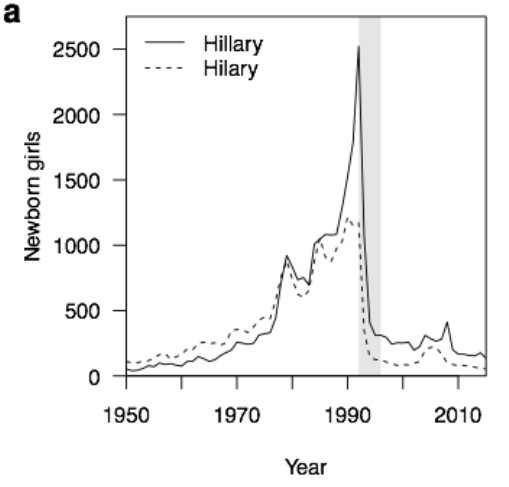
“Hillary” (and its variant “Hilary”) has been trending up in popularity for several decades, but after 1992, when Bill Clinton was elected president and Hillary Clinton was thrust into the limelight, the popularity of this name collapsed. There was a slight recovery to 2009, but then Hillary Clinton became the Secretary of State (from 2009 to 2013), and the popularity of her name started trending down again.
Such naming dynamics “suggest an exceptional negative reaction to Hillary Clinton’s public image.” Returning to the post-1992 collapse, Ghirlanda writes:I show that such a sudden reversal is unique among naming trends, and is also unique to the 1992 election. In other elections between 1884 and 2012, a First Lady’s name had little impact on naming trends. These considerations, and others detailed below, suggest an exceptional negative reaction to Hillary Clinton’s public image, which may have ultimately affected the 2016 election. These results show that identifiable, if subtle cultural trends can foreshadow major social events.Readers of my blog will, no doubt, point out that explaining past patterns is much easier than predicting future dynamics. As Yogi Berra once said, prediction is very hard, especially if it’s about the future.
Fair enough. So let’s test Ghirlanda’s insight. The next election will be held in 2020. Let’s then take a reading in 2019 on how the name “Donald” is faring, and predict whether our current President is going to stay on for the second term.
Blog Archive Comments 20 comments Comments originally published with this post. This archive is read-only.
al loomis
he couldn't win an election today, much less 2020, when a lot of his supporters will be hurting. but there is the 'start a war' ploy. did wonders for dubya.
Edward Turner
Incredible chart! Lots of people predicted Hillary's defeat in the election but all too often these are not 'people' that count as 'people' in discussions among so-called liberals. The initial collapse in popularity 1992 would have been the sudden realisation among American mothers that Hillary was not a unique name. Although there seems to have been a mini-resurgence during the second Bush administration, the name then got a second death when Obama got elected. Not sure if you can directly compare the name Donald and Hillary. The name 'Donald' was famous before Donald Trump as the popular Disney character 'Donald Duck'. Even now when I hear the name Donald I think of a duck. Not immediately. I first think of a Scottish person, then Donald Duck. I don't believe Donald Trump is capable within 4 years of out-charisma staining Donald Duck.
J L Fernandez
It is a very interesting research, but the fact is that Mrs Clinton won the election by 2 million votes above Mr Trump's. She lost the Electoral College, but not the popular vote. So this mathematical evidence would not be wholly consistent with the hypothesis about given names as a good proxy for predicting the presidential results. I think researches should focus on the effect this likely rejection had, indeed, in the contested states where Clinton lost votes to the independent and the green alternative candidates. The latters' votes gave indirectly the Presidency to Mr Trump.
Steve H.
The original paper addresses this and disproves your hypothesis.
J L Fernandez
I am not so sure of this, if we are dealing with Figure 4. The paper did not find strong correlation between the drop in 'Hillary"/"Hillary" across the states and the percentage of Republican vote or the difference between Democratic and Republican vote. The fact that Mrs Clinton won the popular vote cast, indeed, some doubt on the predictive value of the "proxy" (against what is said in the last sentence of the Abstract). True, her public image was damaged by the Lewinski affair and maybe because of the media noise many parents (Republican or Democrats) did not want to give the name to their daughters (it would be interesting to know the statistics about the name 'Monica', as a check). But you cannot predict Mrs Clinton defeat if, in fact, she was not defeated. I understand that she would have grabbed 278 electoral votes, provided she had won Pennsylvania (when she lost by only 60,000 votes), Michigan (only by 11,000), and Wisconsin (27,000). Johnson & Stein got 190,000 votes only in Pennsylvania, for example. I suggest that drop in names would need to be compared not to the Democratic-Republican difference, but to the Democratic vs Everybody else difference in the last presidential election. The extreme and unusual dropping of 'Hillary' name is hard to reconcile with her 64 million votes. A more exact description is to say that she won the election and lost the presidency. The "way" she lost the presidency is the topic to be linked to any "proxy", be this one or another. Otherwise, you would say that, if your name is abruptly getting out of fashion, you'll be soon running for the White House with good chances of winning. The paper shows the 'image-damage' of the Clinton affair when the president got close to an impeachment, but how this damage was translated into an effective 'administrative' defeat (that is, in the Electoral College) remains to be seen.
Stefano Ghirlanda
Hi, This is the author of the study. Thanks for your interest in my research. I agree that presidential elections cannot be predicted by looking at naming trends, not least because the electoral college, with its threshold system in almost all states, amplifies small differences. What I believe the naming trend shows is that Hillary Clinton was remarkably unpopular, which gave her an extra hurdle to overcome to become President. Perhaps low personal appeal may have been the straw that broke the camel's back, but the camel's back has to be already overburdened for a straw to have a big effect. I am not speculating about the many other factors that may have contributed to her defeat.
Karl
To conclude anything from this data, you'd have to know more about the popularity of names of other politicians. As far as know, people generally avoid giving their children the name of any politician. Probably because they know that any politician has enemies (or at the very least opponents) and they don't want to burden their kids with names that might trigger a negative reaction by someone. Don't wait to check in a few years how the name Donald fared. Look at what happened to the names of the last 10 presidents. I guess they all declined in popularity.
Stefano Ghirlanda
Hi, This is the author of the study. Thanks for your interest in my work. As I point out in the paper, Hillary is, by a number of measures, the most extreme of *any* name (I compared it to all names among the most common 1500 that show a popularity since between 1884 and 2012). Hence, it is also the most extreme name among politicians' names. In particular, I compared Hillary to other First Ladies' names, that in general have no discernible pattern around election years. The names of Presidents decline slightly in popularity, typically, but not by much. Many of these names are cultural mainstays (George, William, James, Richard) and their dynamics shows long-term trends (several decades) that appear hard to tie to single events or individuals. Perhaps one could say that, for every bad George pulling the name down, there is a good George pulling the name up. Hillary was a less common name, hence the effects of single events were easier to detect. As for Donald, it is already an unpopular name now, so it will not be easy to see huge changes. Sad. In general, the names of Presidents and First Ladies are not very popular at the time of election because they belong to a past generation, hence are seen as old-fashioned. Hillary was a rare exception in this respect.
Loren Petrich
It seems to me that there may have been a statistical fluke here -- Hillary's name being popular in a faddish way then dropping out just as a Hillary became First Lady. I think that this work ought to be extended to other distinctive names associated with other well-known politicians. How many children have been named Barry? Michelle? Malia? Sasha? Jenna? Chelsea? How many are now being named Ivanka? That would be a valuable test of this hypothesis.
Stefano Ghirlanda
Hi, This is the author of the study. Thanks for your interest in my work. Hillary shows a slow increase (20-odd years on the rise) followed by a fast decrease (90% drops in about 5 years). This is unique among the 630 names that, among the 1500 more popular ones, have undergone a clear popularity cycle between 1884 and 2012. While a coincidence cannot be ruled out, it appears unlikely. (See my reply to another comment regarding comparing Hillary to other politician's names.) Coming to your specific questions, Malia, Sasha, and Barack all show a short lived increase in popularity after 2008. Michelle was on a long downward trend and showed no change in 2008. Chelsea crashes almost as much as Hillary after 1992. Jenna shows a short lived increased in popularity after 2000.
Peter Turchin
Hi all, thanks for your comments. I am going to ask Stefano to respond. Several suggestions on further analyses sound good to me; but again Stefano is better equipped to deal with such questions. Whether you agree with the analysis in the paper, or not, it's a really striking pattern, and a very interesting idea.
J Lane
This seems that the name Donald has been dropping out of use in books since he took a public light in the early 1970s. https://books.google.com/ngrams/graph?content=donald&year_start=1800&year_end=2000&corpus=15&smoothing=3&share=&direct_url=t1%3B%2Cdonald%3B%2Cc0 So couldn't there just as easily have been a paper and headline written "Cultural Evolution Knew What Statistics Didn’t: That Trump Would Lose" and still have been just as valid? This seems to be a postdiction that makes sense after we know the answer.
InnocentBystander
It seems fairly obvious that there's a difference between how often a word is used (and the skewing you get from the piles of pop-political books that come out every year) and naming a child. This all strikes me as a really interesting experiment, but I expect that the real value in the long run will be back-testing against patterns that an AI twizzles out of the morass of data. Speaking as someone who is not a domain expert in history or historical patterns, I have a funny feeling that the real patterns will be ones which are undetectable by humans without aid. Generally (and J Lane didn't succumb to this), I sincerely wish that people would leave their political Tourette's out of these discussions. The Trump-hate gets a bit boring when the talking stick gets passed around.
J Lane
I would agree. I'd also argue that it is fairly obvious that there's a difference between how often a word is used as a name or in a corpus and voting behavior. I would agree that an AI approach is better, not just in this domain, but generally for the study of culture (see below). That being said, I think that this calls into question the simple mathematical formulations as explinations of culture. https://www.academia.edu/6487802/Method_Theory_and_Multi_Agent_Artificial_Intelligence_Creating_computer_models_of_complex_social_interaction I would like to echo your wish for people to leave political Tourette's (great phrase btw) out of such discussion. It detracts from any real progress and usually veils poorly formulated arguments.
Vladimir Dinets
I think assuming that there will be free and somewhat fair elections in 2020 is very optimistic, considering the current tendencies.
InnocentBystander
As a counter example, looking at baby names on nametrends.net , I'm simply not seeing inflection points for Adolph. To take a more modern example, Richard (for Richard Nixon in the early 1970s) doesn't appear to show a really significant change during the Watergate era.
J Lane
I think this is one of those times where it reveals the difference between an interpretive theory and an explanatory theory. What we have here is a theory that can't really predict things until after they've happened. Instead it offers a detailed description of things after they've happened (post-diction/retro-diction).
InnocentBystander
J Lane...or perhaps the difference between a theory and a story. To me, that's the beauty of any kind of predictive models in human behavior. It gives economists and social anthropologists a great opportunity to show that their thinking isn't just a load of bollocks.
J Lane
Generally, I think you're right. Something that I don't see here, in principle or in practice, is how this sort of "explanation" relates to the other fields of science by anything more than weak analogy. There isn't a lot of correspondence that could create a consistent explanation with the rest of what we know through other fields of science.
Guillaume Belanger
That's a cool kind of investigation to do! I had never thought about that before. Thanks.